From the ACE database. Researched and checked against published sources.
Aleister Crowley
1875 to 1947, founder of Thelema, head of the OTO from the mid 1920s, ran the Abbey of Thelema at Cefalù in Sicily from 1920 to 1923
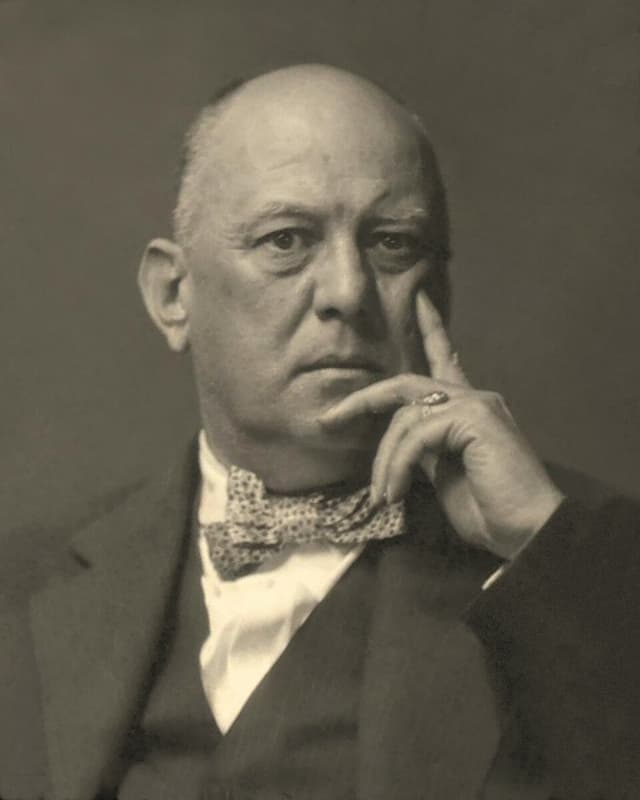
Aleister Crowley, Public domain, via Wikimedia Commons
34/100
ACE Score: 34/100
Low on the scale. An index, not a percentage.
30Low
How total and coercive the leader’s power was.
43Medium
How devoted to and dependent on the leader followers became.
30Low
How hard it was to leave.
(rule-based):Pattern: walls low enough (Bubble Score under 5) for followers to leave fairly easily. A label for these scores, not a forecast. The summary and caveats describe what actually happened.
Scores are an interpretation of published sources using the ACE scoring guide, not findings of fact. Inclusion does not classify anyone as a cult. Disclaimer
Crowley was an English occultist who said that in 1904 a spirit dictated to him The Book of the Law, with the rule 'Do what thou wilt shall be the whole of the Law'. He founded magical orders and led the Ordo Templi Orientis. From 1920 to 1923 he ran a small commune, the Abbey of Thelema, in Sicily, which ended after a young follower died and Mussolini's government expelled him. The British press called him 'the wickedest man in the world', but his groups stayed small and members came and went.
In academic terms, crowley combined a prophetic claim of a new aeon with a small, loosely bound following; closure was moderate and short-lived, and the OTO later routinised his authority.
Where scholars disagree
The case that the framework fits
Accounts by Betty May and the 1920s press describe drug use, sexual rituals, squalor and a death at Cefalù, and Crowley demanded that disciples treat him as the prophet of a new age.
The case that it does not fit, or overstates
Sutin and Kaczynski show a small, chaotic circle of adults who often quarrelled with him and left, with no means to hold members, and argue that press sensation inflated his menace.
The five walls
3 of 10
- 4
1.
Who decides what is real?
Crowley presented The Book of the Law as revealed scripture and himself as its prophet, and his writings were central. Members had full access to outside information and many debated or rejected his views.
- 3
2.
Are friends and family outside the group cut off?
At Cefalù he lived with lovers and their children in a shared household with sexual magic practices. Outside ties were not formally restricted, and most members of his orders lived ordinary lives.
- 3
3.
How hard is it to physically leave?
The Abbey was a small, poor, remote farmhouse, and residents depended on Crowley's money. Visitors such as Betty May left, and the commune ended when he was expelled in 1923.
- 3
4.
Is an apocalypse or a destined triumph always near?
Crowley taught that 1904 began a new 'Aeon of Horus' that would replace the old religions. This is a long-horizon historical claim, not a dated end.
- 2
5.
Does the group decide who deserves to live?
His writings disparaged Christianity and contain antisemitic and contemptuous passages about outsiders. There is no record of organised threats against critics, though he attacked rivals in print and court.
Debt, dependence and harm
4 of 10, medium
How much do followers feel they owe?
Followers gave money, time and sometimes inheritances, and Abbey residents endured drug use, hardship and degrading magical tasks. Commitments outside the commune were moderate.
6 of 10, medium
How far does everything rest on one person?
The A∴A∴ and OTO had grades and offices, but authority rested on Crowley as prophet. After his death in 1947 Karl Germer and later Grady McMurtry kept the OTO going, and it now runs as a legal religious body.
0, little harm, or balanced
When the system turns violent, where does the harm go?
Little lethal violence. Raoul Loveday died at Cefalù in 1923, most likely of enteric illness, and his widow blamed the Abbey's conditions; this harmed a member but was not deliberate killing.
Methods of control
Specific techniques from the historical record that kept followers loyal and the bubble sealed.
- 01Claim of a revealed scripture and prophet role
- 02Graded initiation in magical orders
- 03Oaths and magical records shown to the teacher
- 04Sexual magic within the inner circle
- 05Communal living at a remote site
- 06Financial dependence of residents
Against the reference cases
State power, violence aimed outward
Compared with Hitler
Crowley had no political apparatus and no mass following; the only overlap is a claim to inaugurate a new age.
A sealed group, violence aimed inward
Compared with Jones
Cefalù resembled a tiny version of a leader-centred commune with drugs and sexual control, but it lasted three years, had about a dozen residents and no means to stop people leaving.
Through the theorists
Prophetic charisma founded on revelation, whose routinisation came through an initiatory order rather than through Crowley himself.
Hanegraaff
Belongs to Western esotericism, where secret orders and individual magical practice usually limit group control.
Shows 'sacred science' and 'loading the language', but not milieu control outside the short Cefalù period.
Key sources
Moderate evidence base
- Sutin, Lawrence (2000). Do What Thou Wilt: A Life of Aleister Crowley.
- Kaczynski, Richard (2010). Perdurabo: The Life of Aleister Crowley (Revised and Expanded Edition).
Caveats
Sources are polarised between tabloid accusation and devotee apologetics. Control peaked at Cefalù in 1920 to 1923 and was otherwise low.
Cite this profile
Koziol, T. (2026). Aleister Crowley. In ACE: Authority, Cult & Exit (Version 1.1, pilot database). Ceraluna Labs. https://cultornot.com/leader/aleister-crowley