From the ACE database. Researched and checked against published sources.
Benito Mussolini
1883 to 1945, prime minister of Italy from 1922, dictator from 1925, removed in July 1943, then head of a German puppet state in northern Italy until his execution in April 1945
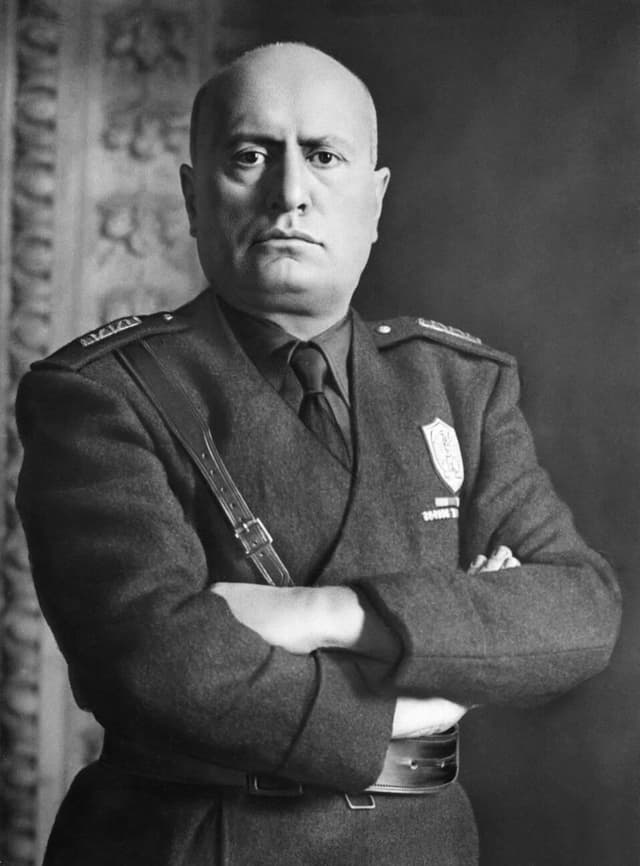
Unknown author, Public domain, via Wikimedia Commons
54/100
ACE Score: 54/100
Medium on the scale. An index, not a percentage.
75High
How total and coercive the leader’s power was.
47Medium
How devoted to and dependent on the leader followers became.
40Medium
How hard it was to leave.
(rule-based):Pattern: a closed system with strong offices, rules and succession. A label for these scores, not a forecast. The summary and caveats describe what actually happened.
Scores are an interpretation of published sources using the ACE scoring guide, not findings of fact. Inclusion does not classify anyone as a cult. Disclaimer
Mussolini founded Fascism and became prime minister after the March on Rome in 1922. By 1926 he had banned other parties and built a dictatorship around his cult as 'il Duce'. His regime used censorship, a secret police and internal exile, but it shared power with the king, the Church and business elites. Abroad, it waged brutal colonial wars in Libya and Ethiopia, using concentration camps and poison gas, and joined Hitler in the Second World War.
In academic terms, mussolini embraced the word 'totalitarian', first used by his critics in 1923, but achieved only partial closure at home; his strongest scores are outward, in colonial violence and wars of aggression.
Where scholars disagree
The case that the framework fits
Gentile argues Fascism was a political religion with its own rituals, martyrs and sacred leader, and Duggan's study of letters shows genuine popular devotion to the Duce.
The case that it does not fit, or overstates
Bosworth and Renzo De Felice stress how much power Mussolini shared with traditional elites, and Arendt did not count Fascist Italy as fully totalitarian. Many Italians conformed without belief.
The five walls
5.6 of 10
- 7
1.
Who decides what is real?
The 'very fascist laws' of 1925 and 1926 placed the press under state control, and from 1937 a Ministry of Popular Culture directed news and the arts. The slogan 'Mussolini is always right' appeared on walls across Italy, and open dissent led to prison or exile.
- 4
2.
Are friends and family outside the group cut off?
Youth groups such as the Opera Nazionale Balilla enrolled most children, and the regime urged large families. The family and the Catholic Church, protected by the 1929 Lateran Pacts, kept considerable independence.
- 4
3.
How hard is it to physically leave?
Opponents could be sent to 'confino', internal exile on islands or remote villages, and passports were withdrawn from suspects. Borders were not sealed, and many anti-Fascists escaped abroad.
- 5
4.
Is an apocalypse or a destined triumph always near?
Fascism promised a national rebirth and a new Roman Empire, dating years from the March on Rome. This shaped ritual and policy but did not predict an imminent end.
- 8
5.
Does the group decide who deserves to live?
In Libya around 1930 to 1933, much of the population of Cyrenaica was forced into concentration camps where tens of thousands died. In Ethiopia the army used mustard gas, and after an attempt on the viceroy in 1937 Italian forces massacred thousands in Addis Ababa.
Debt, dependence and harm
5 of 10, medium
How much do followers feel they owe?
Party membership became necessary for many state jobs, and in 1931 university professors had to swear an oath to the regime; only about a dozen refused. In 1935 millions of Italians gave their wedding rings to fund the Ethiopian war.
4 of 10, medium
How far does everything rest on one person?
The monarchy, army and Church remained as independent power centres. In July 1943 the Fascist Grand Council voted against Mussolini and the king dismissed and arrested him, which shows institutions could remove him.
+9, mostly outsiders
When the system turns violent, where does the harm go?
The main lethal violence fell on colonial subjects in Libya and Ethiopia and on countries Italy attacked, including Albania, Greece and Yugoslavia, all outward. Persecution of anti-Fascists and, from 1938, of Italian Jews also counts as outward, while violence against the party's own ranks was minor.
Methods of control
Specific techniques from the historical record that kept followers loyal and the bubble sealed.
- 01Duce cult and mass rallies
- 02State control of press and culture
- 03Internal exile ('confino') and the OVRA secret police
- 04Youth organisations
- 05Loyalty oaths and party cards for jobs
- 06Colonial terror and concentration camps
- 07Racial laws from 1938
Against the reference cases
State power, violence aimed outward
Compared with Hitler
Mussolini's cult and outward aggression foreshadowed Hitler, but his domestic control was much weaker and he could be removed by the king.
A sealed group, violence aimed inward
Compared with Jones
Mussolini demanded devotion like Jones, but did not seal his followers off from the world or turn violence inward on them.
Through the theorists
The Duce cult was charismatic, but it rested on a bargain with traditional and legal authority held by the king and the Church.
Gentile
Fascism 'sacralised' politics, treating the nation as a faith with its own liturgy.
Italy was a single-party dictatorship that never achieved the total terror Arendt saw as the core of totalitarianism.
Key sources
Strong evidence base
- Gentile, Emilio (1996). The Sacralization of Politics in Fascist Italy.
- Bosworth, R. J. B. (2002). Mussolini.
- Duggan, Christopher (2012). Fascist Voices: An Intimate History of Mussolini's Italy.
Caveats
Scores reflect the peak of the regime in the 1930s. The puppet Italian Social Republic of 1943 to 1945 was more violent at home. Estimates of colonial death tolls vary, and the 1938 racial laws added persecution of Italian Jews. On the vector, colonial killings, wars and the persecution of opponents and Jews count as outward; there was no large-scale violence against the Fascist movement or its base, so nearly all lethal harm falls on the outward side.
Cite this profile
Koziol, T. (2026). Benito Mussolini. In ACE: Authority, Cult & Exit (Version 1.1, pilot database). Ceraluna Labs. https://cultornot.com/leader/benito-mussolini