From the ACE database. Researched and checked against published sources.
Bhagwan Shree Rajneesh (Osho)
1931 to 1990, leader of the Rajneesh movement, with the ashram in Pune from 1974 and the Rajneeshpuram commune in Oregon from 1981 to 1985
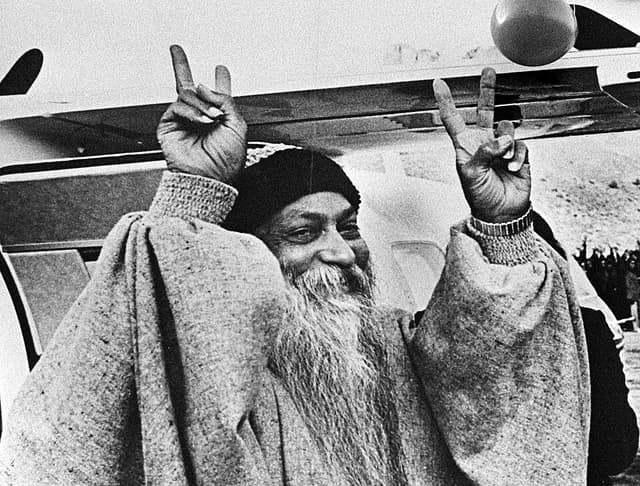
Marcel Antonisse / Anefo, CC0, via Wikimedia Commons
58/100
ACE Score: 58/100
Medium on the scale. An index, not a percentage.
55Medium
How total and coercive the leader’s power was.
63Medium
How devoted to and dependent on the leader followers became.
55Medium
How hard it was to leave.
(rule-based):Pattern: a closed system with little institutional restraint, where harm was aimed mainly at outsiders. A label for these scores, not a forecast. The summary and caveats describe what actually happened.
Scores are an interpretation of published sources using the ACE scoring guide, not findings of fact. Inclusion does not classify anyone as a cult. Disclaimer
Rajneesh was an Indian philosophy lecturer who gathered Western disciples in Pune from 1974 with a mix of meditation, therapy and sexual openness. In 1981 the movement moved to a ranch in Oregon and built the city of Rajneeshpuram. While Rajneesh kept public silence, his secretary Ma Anand Sheela ran the commune, armed a security force and, in 1984, organised a salmonella poisoning of salad bars in The Dalles that sickened 751 people. Rajneesh left the United States in 1985 under a plea deal on immigration fraud charges and died in Pune in 1990.
In academic terms, rajneeshpuram shows high spatial and moderate epistemic closure under a delegated, unroutinised authority, with violence pushed outward against local opponents. Carter argues the commune had few shared values beyond devotion to Rajneesh and relied on control, which collapsed once Sheela fled.
Where scholars disagree
The case that the framework fits
Carter, FitzGerald and court records document armed security, surveillance, voter fraud schemes, the bioterror attack and murder plots, showing a commune that used coercion to protect itself.
The case that it does not fit, or overstates
Urban and Palmer note that Rajneesh's teaching stressed individual freedom, that the Pune ashram was open and largely voluntary, and that the crimes were run by Sheela's group; scholars still disagree about how much Rajneesh knew.
The five walls
5.6 of 10
- 5
1.
Who decides what is real?
Rajneesh's talks were the central teaching and, during his silence from 1981 to 1984, Sheela controlled what members heard from him. Doubt was treated as 'mind' to be dropped, though members could read outside news.
- 5
2.
Are friends and family outside the group cut off?
Disciples were urged to drop conventional family ties, children lived in communal quarters, and many members were encouraged to be sterilised. Couples formed and dissolved freely under commune norms.
- 6
3.
How hard is it to physically leave?
Rajneeshpuram was a remote ranch with an armed Peace Force, checkpoints and, as later investigations found, wiretapping of residents. Members worked long unpaid shifts and depended on the commune for housing and food.
- 6
4.
Is an apocalypse or a destined triumph always near?
From 1983 the commune relayed Rajneesh's warnings of coming catastrophes such as nuclear war, describing itself as a Noah's Ark of consciousness, and in 1984 Sheela announced his prediction that AIDS would kill two-thirds of humanity. This framing justified building self-sufficiency in Oregon.
- 6
5.
Does the group decide who deserves to live?
Sheela's circle carried out the 1984 salmonella attack and planned the murder of US Attorney Charles Turner, and tried to poison Rajneesh's physician. No deaths resulted.
Debt, dependence and harm
6 of 10, medium
How much do followers feel they owe?
Commune members worked twelve-hour days described as 'worship' and many donated savings and property. Rajneesh's collection of Rolls-Royces was paid for by followers.
7 of 10, high
How far does everything rest on one person?
Sheela and a small circle held large practical power, but it rested entirely on Rajneesh's favour and the commune collapsed when she left in 1985. After his death a council ran the Pune resort.
+4, mostly outsiders
When the system turns violent, where does the harm go?
Serious violence was aimed at outsiders, chiefly the bioterror attack and murder plots, with lesser harm to insiders through poisoning attempts and surveillance.
Methods of control
Specific techniques from the historical record that kept followers loyal and the bubble sealed.
- 01Delegated control through a personal secretary
- 02Armed security force and checkpoints
- 03Work as worship with long unpaid shifts
- 04Communal childrearing and discouraging parenthood
- 05Apocalyptic Noah's Ark framing
- 06Surveillance of residents
Against the reference cases
State power, violence aimed outward
Compared with Hitler
Like Hitler, the Rajneeshpuram leadership used a uniformed force and targeted outside 'enemies', but on a local scale and without killing.
A sealed group, violence aimed inward
Compared with Jones
Rajneeshpuram shared Jonestown's remote enclave and apocalyptic framing, but its violence pointed outward and it ended in collapse rather than mass death.
Through the theorists
Rajneesh's charisma stayed personal; delegation to Sheela produced power without legitimacy and the commune fell apart once she was exposed.
Carter
The commune lacked shared values and relied on control, which explains its rapid collapse.
Urban
The movement fused spirituality with consumer capitalism, selling liberation as a global brand.
Key sources
Strong evidence base
- Carter, Lewis F. (1990). Charisma and Control in Rajneeshpuram: The Role of Shared Values in the Creation of a Community.
- Palmer, Susan J., and Arvind Sharma (1993). The Rajneesh Papers: Studies in a New Religious Movement.
- Urban, Hugh B. (2015). Zorba the Buddha: Sex, Spirituality, and Capitalism in the Global Osho Movement.
Caveats
Scores describe Rajneeshpuram from 1981 to 1985; the Pune periods were much less closed. Evidence about Rajneesh's personal role in the crimes is contested, since Sheela and Rajneesh blamed each other.
Cite this profile
Koziol, T. (2026). Bhagwan Shree Rajneesh (Osho). In ACE: Authority, Cult & Exit (Version 1.1, pilot database). Ceraluna Labs. https://cultornot.com/leader/bhagwan-shree-rajneesh