From the ACE database. Researched and checked against published sources.
A. C. Bhaktivedanta Swami Prabhupada
1896 to 1977, founder of ISKCON, active in New York from 1965 and then worldwide until his death in Vrindavan
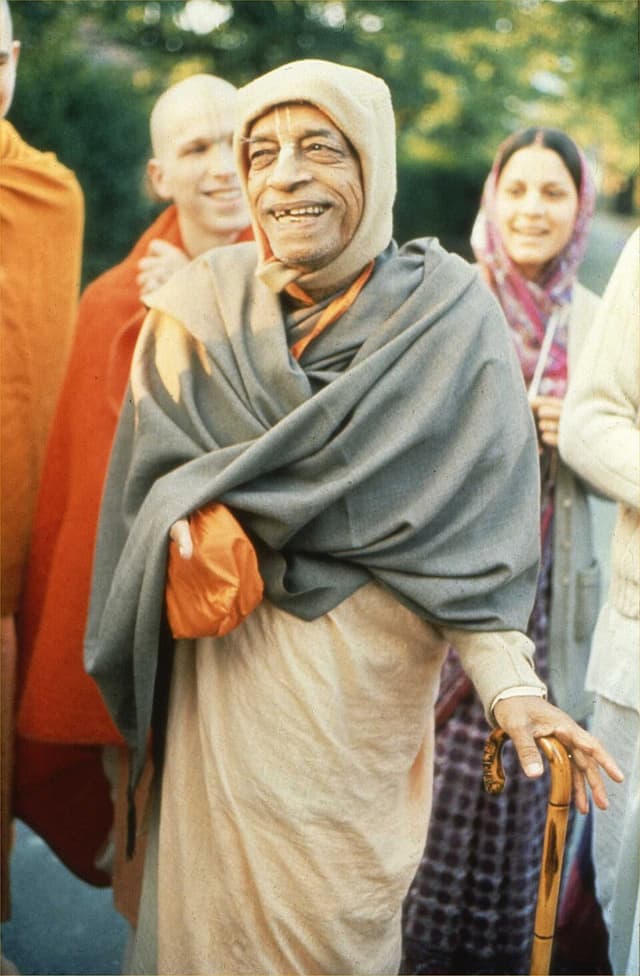
Christian Jansen, CC BY 3.0, via Wikimedia Commons
46/100
ACE Score: 46/100
Medium on the scale. An index, not a percentage.
40Medium
How total and coercive the leader’s power was.
47Medium
How devoted to and dependent on the leader followers became.
50Medium
How hard it was to leave.
(rule-based):Pattern: walls low enough (Bubble Score under 5) for followers to leave fairly easily. A label for these scores, not a forecast. The summary and caveats describe what actually happened.
Scores are an interpretation of published sources using the ACE scoring guide, not findings of fact. Inclusion does not classify anyone as a cult. Disclaimer
Prabhupada arrived in New York in 1965 aged 69 and founded ISKCON in 1966. He taught devotion to Krishna through chanting, strict rules against meat, intoxicants, gambling and illicit sex, and temple life under his initiated disciples. Many young Western converts moved into temples, shaved their heads and spent long days distributing his books. This profile covers his own leadership period, before the guru succession crisis and later scandals.
In academic terms, under Prabhupada ISKCON combined moderate epistemic and social closure (temple ashrams, boarding schools for children) with high devotion debt, but low existential and temporal closure. A governing body existed, yet his death exposed how much authority rested on him personally.
Where scholars disagree
The case that the framework fits
Temple life, arranged marriages, boarding schools and total time commitment fit models of high-demand groups. Rochford documents how the movement's early structure left children exposed to abuse and members economically dependent, though most abuse cases surfaced after 1977.
The case that it does not fit, or overstates
Shinn and many scholars of Hinduism stress that ISKCON belongs to a centuries-old devotional tradition, that Prabhupada did not claim to be God, and that brainwashing accounts misread ordinary religious conversion. ISKCON has since become a largely congregational movement with many members living outside temples.
The five walls
4.2 of 10
- 5
1.
Who decides what is real?
Prabhupada's translations and commentaries were treated as authoritative scripture, and worldly knowledge was dismissed as maya, or illusion. Doubt was framed as spiritual weakness, though members were not cut off from outside media by force.
- 6
2.
Are friends and family outside the group cut off?
Temple residents lived in sex-segregated ashrams, and marriages were arranged or approved by leaders. From the early 1970s many children were sent to gurukula boarding schools away from their parents, and outsiders were called 'karmis'.
- 4
3.
How hard is it to physically leave?
Most committed members lived in temples and farm communities and depended on them for food and housing. Leaving carried practical costs but was not physically prevented.
- 3
4.
Is an apocalypse or a destined triumph always near?
Prabhupada taught that the world was in the degraded age of Kali Yuga and that chanting could start a golden age. This framing was long-horizon rather than an imminent dated end.
- 3
5.
Does the group decide who deserves to live?
Non-devotees were described as materialists, 'demons' or animals in human form in some teachings. There was no sanctioned violence against outsiders in his lifetime.
Debt, dependence and harm
6 of 10, medium
How much do followers feel they owe?
Temple devotees gave up careers and property, followed strict vows including celibacy outside marriage, and spent long hours on book distribution and fundraising. Their livelihood depended on the temple.
5 of 10, medium
How far does everything rest on one person?
Prabhupada created a Governing Body Commission in 1970 and a book trust, giving ISKCON a working structure. His succession instructions were ambiguous, and the eleven-guru system that followed his death in 1977 produced years of conflict.
-1, little harm, or balanced
When the system turns violent, where does the harm go?
Rochford and Heinlein (1998) documented physical, emotional and sexual abuse of children in ISKCON gurukula schools between 1971 and 1986; some began in Prabhupada's lifetime, but much of it, and its public exposure in the 1990s, came after his death. No lethal violence occurred under Prabhupada, and the killings linked to New Vrindaban came in the 1980s.
Methods of control
Specific techniques from the historical record that kept followers loyal and the bubble sealed.
- 01Daily chanting quota of sixteen rounds
- 02Four regulative principles governing diet and sex
- 03Temple ashram residence with sex segregation
- 04Book distribution and fundraising as devotional service
- 05Gurukula boarding schools separating children from parents
- 06Initiation vows binding disciple to guru
Against the reference cases
State power, violence aimed outward
Compared with Hitler
Prabhupada held no political power and the movement directed no violence outward. The common ground is only reverence for a teacher whose word settled disputes.
A sealed group, violence aimed inward
Compared with Jones
Unlike Jonestown, ISKCON temples were urban and open, and members could leave. The child abuse problem is a point of concern, but there was no apocalyptic isolation or mass death.
Through the theorists
Prabhupada's charisma was attached to an existing lineage office, which made routinisation possible but also triggered a succession crisis when no clear heir was named.
Temples and gurukulas functioned in part as total institutions, regulating sleep, food, dress and contact in one place.
Rochford
The shift from communal temple life to congregational membership during the 1980s shows how economic pressure and family life transformed a high-demand movement.
Key sources
Strong evidence base
- Rochford, E. Burke, Jr. (1985). Hare Krishna in America.
- Rochford, E. Burke, Jr. (2007). Hare Krishna Transformed.
- Shinn, Larry D. (1987). The Dark Lord: Cult Images and the Hare Krishnas in America.
Caveats
Scores apply to 1966 to 1977 only; abuse revelations, guru scandals and violence at New Vrindaban came later. ISKCON-sponsored sources tend to be hagiographic, while anti-cult literature of the 1970s is often hostile. The full extent of gurukula abuse during his lifetime became public only in the 1990s.
Cite this profile
Koziol, T. (2026). A. C. Bhaktivedanta Swami Prabhupada. In ACE: Authority, Cult & Exit (Version 1.1, pilot database). Ceraluna Labs. https://cultornot.com/leader/bhaktivedanta-swami-prabhupada