From the ACE database. Researched and checked against published sources.
Francisco Franco
1892 to 1975, Nationalist leader in the Spanish Civil War from 1936 and dictator of Spain until his death in November 1975
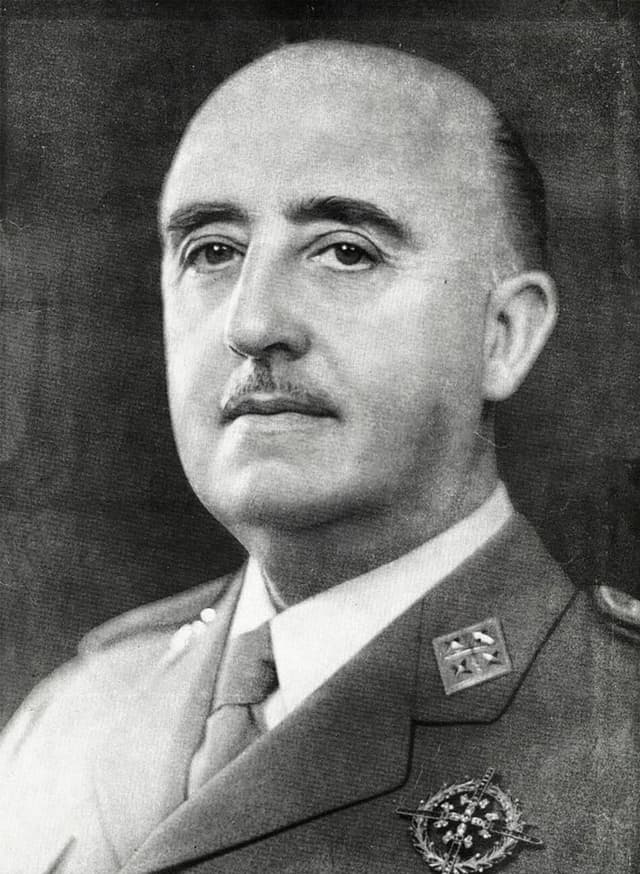
Unknown author, CC0, via Wikimedia Commons
59/100
ACE Score: 59/100
Medium on the scale. An index, not a percentage.
80High
How total and coercive the leader’s power was.
43Medium
How devoted to and dependent on the leader followers became.
55Medium
How hard it was to leave.
(rule-based):Pattern: a closed system with strong offices, rules and succession. A label for these scores, not a forecast. The summary and caveats describe what actually happened.
Scores are an interpretation of published sources using the ACE scoring guide, not findings of fact. Inclusion does not classify anyone as a cult. Disclaimer
Franco was a general who led the Nationalist rebellion against the Spanish Republic in 1936 and won the Civil War in 1939. He ruled as Caudillo for 36 years with the support of the army, the Catholic Church and a single movement that absorbed the fascist Falange. In the war and the years after it, his side killed well over 100,000 political opponents, and hundreds of thousands were jailed or forced into exile. From the 1950s the regime became less violent and more technocratic. Franco named Juan Carlos as his successor, and Spain became a democracy after his death.
In academic terms, franco combines very high early existential closure, framed as a religious crusade against 'anti-Spain', with comparatively strong routinization; the regime bound citizens through fear, Church and complicity rather than through a sacred leader-cult.
Where scholars disagree
The case that the framework fits
Preston and others argue that the scale and intent of the repression justify comparison with other exterminatory regimes, and the regime used Catholic ritual to sacralise the Caudillo.
The case that it does not fit, or overstates
Juan Linz used Franco's Spain as the model of an 'authoritarian' rather than totalitarian regime: limited pluralism, no guiding ideology, and demobilisation rather than mass mobilisation. Stanley Payne also stresses its evolution into a developmentalist dictatorship.
The five walls
6.2 of 10
- 7
1.
Who decides what is real?
The 1938 Press Law placed all publications under prior censorship, and schooling was rebuilt around National Catholicism. Censorship eased somewhat after the 1966 Press Law but never ended under Franco.
- 6
2.
Are friends and family outside the group cut off?
Families of defeated Republicans were stigmatised, and children of imprisoned 'reds' were taken into state and Church institutions. The Women's Section of the Falange and the Church steered marriage and child-rearing toward a Catholic model.
- 5
3.
How hard is it to physically leave?
In 1939 about 450,000 people fled to France, and hundreds of thousands passed through camps and prisons in Spain. Exiles could not return safely, though from the 1960s large-scale labour emigration to Europe was allowed.
- 4
4.
Is an apocalypse or a destined triumph always near?
The war was presented as a 'Crusade' to save Christian Spain from communism and freemasonry. This destiny framing shaped regime rhetoric, but no end-time was predicted.
- 9
5.
Does the group decide who deserves to live?
Nationalist forces carried out systematic killings behind the lines during the war, and around 20,000 people were executed after 1939 according to Paul Preston. Opponents were labelled 'anti-Spain' and treated as a disease to be purged.
Debt, dependence and harm
5 of 10, medium
How much do followers feel they owe?
The 1939 Law of Political Responsibilities punished past political activity, and jobs in teaching and the civil service required proof of political and religious reliability. Denunciations were encouraged in the early years.
4 of 10, medium
How far does everything rest on one person?
The 1947 Law of Succession declared Spain a kingdom, and in 1969 Franco named Juan Carlos as his successor under that law. Ministries and the army worked as a real bureaucracy, though Franco balanced its factions personally.
+8, mostly outsiders
When the system turns violent, where does the harm go?
Under the regime rule, the killing of defeated Republicans, leftists, trade unionists and regional nationalists counts as outward, because the regime defined them as 'anti-Spain'; historians' estimates for killings by Franco's side during and after the war mostly run from about 100,000 to 200,000. Inward violence against his own camp was minor, and Spain stayed out of the Second World War apart from the volunteer Blue Division.
Methods of control
Specific techniques from the historical record that kept followers loyal and the bubble sealed.
- 01Mass executions and military tribunals after the war
- 02Prior censorship of press and publishing
- 03National Catholic education and Church moral control
- 04Purges and political-reliability certificates for public jobs
- 05Concentration camps, prisons and forced labour, including on the Valley of the Fallen
- 06A single official movement absorbing the Falange
Against the reference cases
State power, violence aimed outward
Compared with Hitler
Franco took aid from Hitler and shared his anti-communism, but his regime was more conservative and clerical and did not pursue genocide or territorial war.
A sealed group, violence aimed inward
Compared with Jones
Unlike Jones, Franco relied on army and Church institutions rather than personal magnetism, and his followers were never asked to die for him.
Through the theorists
Franco's authority began in victory and charismatic military prestige but was routinised into traditional and legal forms through monarchy and law.
Linz
Linz's definition of authoritarian regimes was built on Franco's Spain: limited pluralism, mentalities rather than ideology, and low mobilisation.
Arendt's criteria for totalitarianism, a mass movement and permanent terror, fit the war and early 1940s better than the later regime.
Key sources
Strong evidence base
- Preston, Paul (1993). Franco: A Biography.
- Preston, Paul (2012). The Spanish Holocaust: Inquisition and Extermination in Twentieth-Century Spain.
- Payne, Stanley G. (1987). The Franco Regime, 1936–1975.
Caveats
Scores reflect the peak period of 1936 to the late 1940s; by the 1960s epistemic, spatial and existential closure were much lower. Death toll figures are still debated: scholarly estimates of Francoist killings range from under 60,000 to several hundred thousand, with most between about 100,000 and 200,000, and many victims lie in unmarked graves. Almost all of these deaths fall on the outward side of the vector; purges within the Nationalist camp were small. Linz's work makes 'Authoritarian ruler' a better fit than totalitarian.
Cite this profile
Koziol, T. (2026). Francisco Franco. In ACE: Authority, Cult & Exit (Version 1.1, pilot database). Ceraluna Labs. https://cultornot.com/leader/francisco-franco