From the ACE database. Researched and checked against published sources.
Mao Zedong
1893 to 1976, leader of the Chinese Communist Party from the 1930s and ruler of the People's Republic of China from 1949 until his death in September 1976
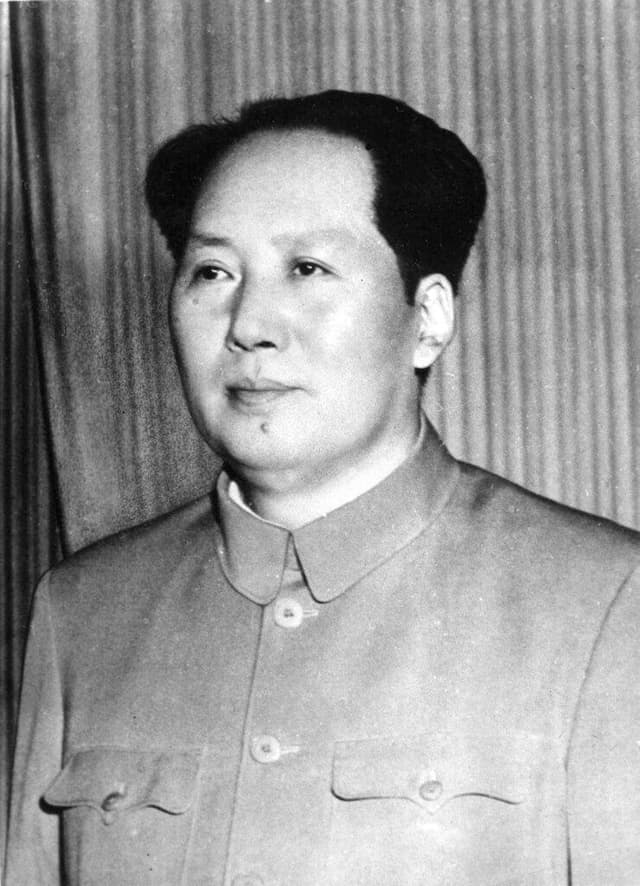
Chen Zhengqing (1917–1966), Public domain, via Wikimedia Commons
80/100
ACE Score: 80/100
High on the scale. An index, not a percentage.
95High
How total and coercive the leader’s power was.
70High
How devoted to and dependent on the leader followers became.
75High
How hard it was to leave.
(rule-based):Pattern: a closed system with little institutional restraint, where harm was aimed mainly at its own people. A label for these scores, not a forecast. The summary and caveats describe what actually happened.
Scores are an interpretation of published sources using the ACE scoring guide, not findings of fact. Inclusion does not classify anyone as a cult. Disclaimer
Mao led the Communists to victory in China's civil war in 1949. His Great Leap Forward from 1958 forced peasants into giant communes and caused a famine that killed tens of millions; most scholarly estimates fall between about 15 and 45 million. In the Cultural Revolution from 1966 he mobilised young Red Guards against party officials, teachers and 'class enemies'. A huge personality cult, including the 'Little Red Book' of his quotations, made his words close to sacred.
In academic terms, mao's China pairs very high epistemic, social and debt closure through thought reform with low routinization, since the leader deliberately broke his own party apparatus to keep revolution permanent.
Where scholars disagree
The case that the framework fits
Robert Jay Lifton's study of Chinese thought reform became a founding text in the study of cults, and MacFarquhar and Schoenhals document how far the Cultural Revolution depended on Mao's personal cult.
The case that it does not fit, or overstates
Some historians stress that local officials and factions drove much of the violence, and that the famine deaths came from policy failure and fear of reporting bad news rather than an intent to kill. The scale of the famine toll itself is contested.
The five walls
8.2 of 10
- 9
1.
Who decides what is real?
The party controlled all media, and Mao's quotations were studied daily and recited at meetings during the Cultural Revolution. Doubt was attacked in public 'struggle sessions', and foreign information was largely unavailable.
- 8
2.
Are friends and family outside the group cut off?
Communes in 1958 ran communal dining halls and organised labour by brigade rather than household. During the Cultural Revolution children were urged to denounce parents, and some 17 million urban youths were sent to the countryside.
- 7
3.
How hard is it to physically leave?
The household registration (hukou) system from 1958 tied people to their village or city. Leaving the country was forbidden for most, although many thousands fled to Hong Kong.
- 7
4.
Is an apocalypse or a destined triumph always near?
During the Great Leap, leaders promised that communism was imminent and that China would overtake Britain in steel within 15 years. Mao's doctrine of 'continuous revolution' and constant preparation for war kept society in a state of emergency.
- 10
5.
Does the group decide who deserves to live?
Landlords, 'rightists' and 'class enemies' were branded enemies of the people. Land reform and the 1950 to 1951 campaign against 'counter-revolutionaries' killed from several hundred thousand to two million or more, and the Great Leap famine killed roughly 15 to 45 million, depending on the estimate.
Debt, dependence and harm
8 of 10, high
How much do followers feel they owe?
Work units controlled jobs, housing, food and permission to marry. Thought reform demanded written self-criticism and confession, and denouncing others was a test of loyalty.
6 of 10, medium
How far does everything rest on one person?
The party and state bureaucracy were large, but Mao launched the Cultural Revolution partly to attack them. Both of his designated successors fell: Liu Shaoqi died in custody in 1969 and Lin Biao died fleeing in 1971.
-4, mostly insiders
When the system turns violent, where does the harm go?
Outward: landlords and 'counter-revolutionaries' killed in the early 1950s, 'class enemies' killed in the Cultural Revolution, the crushing of the 1959 Tibetan uprising and the intervention in the Korean War. Inward: the Great Leap famine, which killed tens of millions of the peasants the regime claimed as its base, and the persecution of party cadres, so the net direction is clearly inward.
Methods of control
Specific techniques from the historical record that kept followers loyal and the bubble sealed.
- 01Thought reform and struggle sessions
- 02Daily study of Mao's quotations
- 03Household registration tying people to place
- 04Work-unit control of food, jobs and housing
- 05Mass campaigns against labelled enemies
- 06Mobilising youth against parents and teachers
- 07Sending urban youth to the countryside
Against the reference cases
State power, violence aimed outward
Compared with Hitler
Both regimes used a leader cult and mass mobilisation, but most of the dead under Mao were Chinese peasants who starved in the famine, while Hitler's victims were mostly racial outsiders and foreign populations.
A sealed group, violence aimed inward
Compared with Jones
Mao's struggle sessions resemble Jones's public humiliation meetings, scaled up to a country of hundreds of millions and without a final collective suicide.
Through the theorists
Mao resisted routinisation by repeatedly mobilising the masses against the bureaucracy his own revolution had created.
Lifton's 1961 study of Chinese thought reform defined 'ideological totalism', including milieu control, confession and loading the language.
Mass campaigns that kept society in motion match Arendt's point that totalitarian movements need constant upheaval to survive.
Key sources
Strong evidence base
- Dikötter, Frank (2010). Mao's Great Famine: The History of China's Most Devastating Catastrophe, 1958–1962.
- MacFarquhar, Roderick, and Michael Schoenhals (2006). Mao's Last Revolution.
- Lifton, Robert Jay (1961). Thought Reform and the Psychology of Totalism: A Study of 'Brainwashing' in China.
Caveats
Control varied greatly between the relatively calmer early 1950s, the Great Leap from 1958 to 1962, and the Cultural Revolution from 1966. Estimates of famine deaths range widely and Dikötter's figure of 45 million is at the high end. On the vector, killings of landlords, 'counter-revolutionaries' and Cultural Revolution 'class enemies' (estimates for 1966 to 1976 range from several hundred thousand to about two million), Tibet and the Korean War count as outward; famine deaths among peasants and purges of party cadres count as inward. Because the famine far outweighs the rest, the net is inward even though most deliberate killing was aimed at defined enemies. Chinese archives remain partly closed.
Cite this profile
Koziol, T. (2026). Mao Zedong. In ACE: Authority, Cult & Exit (Version 1.1, pilot database). Ceraluna Labs. https://cultornot.com/leader/mao-zedong