From the ACE database. Researched and checked against published sources.
Mobutu Sese Seko
1930 to 1997, army chief who seized power in 1965 and ruled Congo, renamed Zaire in 1971, until rebels drove him out in May 1997
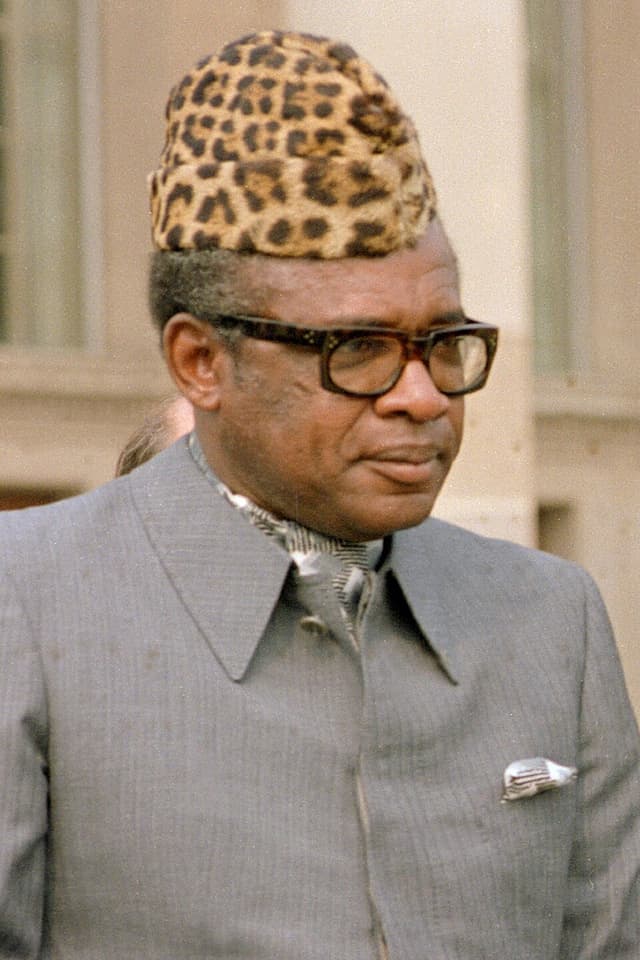
Frank Hall, Public domain, via Wikimedia Commons
48/100
ACE Score: 48/100
Medium on the scale. An index, not a percentage.
65Medium
How total and coercive the leader’s power was.
43Medium
How devoted to and dependent on the leader followers became.
35Low
How hard it was to leave.
(rule-based):Pattern: walls low enough (Bubble Score under 5) for followers to leave fairly easily. A label for these scores, not a forecast. The summary and caveats describe what actually happened.
Scores are an interpretation of published sources using the ACE scoring guide, not findings of fact. Inclusion does not classify anyone as a cult. Disclaimer
Mobutu was the army chief who took power in Congo in 1965 with Western backing during the Cold War. He renamed the country Zaire, made his party, the MPR, the only legal organisation, and declared every citizen a member from birth. His 'authenticity' campaign banned Christian first names and Western suits and spread the doctrine of 'Mobutism'. He and his circle drained state wealth on a vast scale while public services collapsed. Opponents were bought off, jailed or killed, and he fled in 1997 when Laurent-Désiré Kabila's forces took Kinshasa.
In academic terms, mobutu shows how a leader-cult and party-state can claim total membership while actually binding people mainly through patronage and scarcity; closure was broad but shallow, with violence used selectively against elites and protesters.
Where scholars disagree
The case that the framework fits
The 'birth membership' in the MPR, compulsory praise rituals and quasi-religious language around the 'Guide' fit the profile of a manufactured political cult.
The case that it does not fit, or overstates
Crawford Young and Thomas Turner describe a weak, decaying state whose reach was limited; many scholars see Mobutu's rule as patrimonial kleptocracy where cynicism, not belief, was the norm.
The five walls
4.4 of 10
- 6
1.
Who decides what is real?
The press was state-controlled, and daily radio and television featured Mobutu, including the evening news opening with his image descending through clouds. Mobutism was taught as official doctrine.
- 4
2.
Are friends and family outside the group cut off?
The authenticity campaign forced people to drop Christian names, and the MPR placed party cells in workplaces and villages. Ordinary family structures were left largely intact.
- 3
3.
How hard is it to physically leave?
Zaireans were not generally prevented from leaving, and many opponents went into exile in Belgium. Internal control was weak across much of the vast country.
- 2
4.
Is an apocalypse or a destined triumph always near?
Rhetoric presented Mobutu as the founder and guide of a reborn African nation. There was no apocalyptic framing.
- 7
5.
Does the group decide who deserves to live?
In 1966 four former ministers were publicly hanged in Kinshasa before a large crowd, and rebel leader Pierre Mulele was tortured to death in 1968 after being promised amnesty. Security forces killed students at Lubumbashi University in 1990.
Debt, dependence and harm
4 of 10, medium
How much do followers feel they owe?
Party membership was automatic, and citizens were required to take part in 'political animation' sessions of praise songs and dances. Livelihoods in the state sector depended on patronage, but the state offered little to depend on.
7 of 10, high
How far does everything rest on one person?
The MPR and ministries existed on paper, but Mobutu constantly rotated officials to stop rivals building power bases. There was no succession plan and the state collapsed as he fell.
+5, mostly outsiders
When the system turns violent, where does the harm go?
Lethal violence fell mainly on groups the regime treated as enemies, which count as outward: rebels such as Mulele's followers, former politicians hanged in 1966 and protesting students. Periodic purges and executions of his own army officers count as inward but were smaller; Zaire also intervened in Angola's civil war, backing the FNLA and later UNITA.
Methods of control
Specific techniques from the historical record that kept followers loyal and the bubble sealed.
- 01Single party with membership from birth
- 02Authenticity campaign renaming people and places
- 03Compulsory 'political animation' praise rituals
- 04Patronage, co-optation and rotation of elites
- 05Public executions and selective killings of rivals
- 06Control of mineral revenue for personal enrichment
Against the reference cases
State power, violence aimed outward
Compared with Hitler
Mobutu borrowed the forms of a party-state and leader-cult but lacked a mobilising ideology, and his regime decayed rather than expanding.
A sealed group, violence aimed inward
Compared with Jones
Like Jones, Mobutu demanded ritual displays of devotion, but most Zaireans kept independent family and economic lives.
Through the theorists
Mobutu's rule is a clear case of patrimonialism, where the state was the ruler's household and office was a source of personal income.
Chehabi and Linz
Zaire under Mobutu is often cited as a sultanistic regime in their sense: personalism, corruption and a cult masking a hollow state.
Jean-François Bayart
Bayart's 'politics of the belly' captures how loyalty was secured by sharing access to state resources.
Key sources
Strong evidence base
- Young, Crawford, and Thomas Turner (1985). The Rise and Decline of the Zairian State.
- Wrong, Michela (2000). In the Footsteps of Mr Kurtz: Living on the Brink of Disaster in the Congo.
Caveats
Violence and control varied greatly by region and period; the 1960s consolidation and 1990s decay differ sharply. Most lethal violence falls on the outward side of the vector (rebels, rivals outside the regime, protesters), with purges of officers on the inward side.
Cite this profile
Koziol, T. (2026). Mobutu Sese Seko. In ACE: Authority, Cult & Exit (Version 1.1, pilot database). Ceraluna Labs. https://cultornot.com/leader/mobutu-sese-seko