From the ACE database. Researched and checked against published sources.
Nicolae Ceaușescu
1918 to 1989, General Secretary of the Romanian Communist Party from 1965 and head of state from 1967 until his overthrow and execution in December 1989
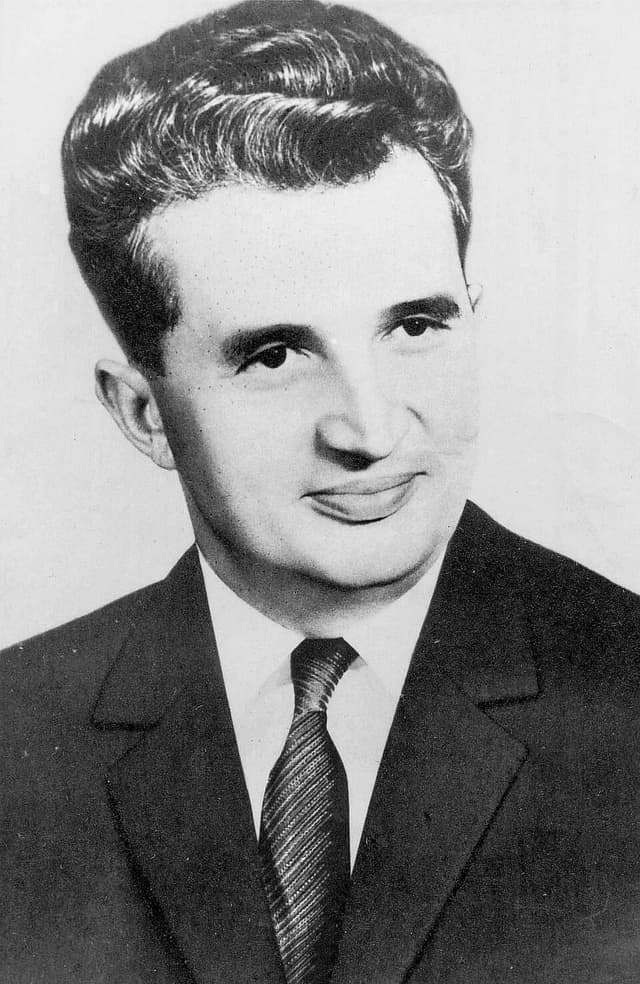
unknown, Attribution, via Wikimedia Commons
66/100
ACE Score: 66/100
Medium on the scale. An index, not a percentage.
75High
How total and coercive the leader’s power was.
53Medium
How devoted to and dependent on the leader followers became.
70High
How hard it was to leave.
(rule-based):Pattern: a closed system with little institutional restraint, where harm was aimed mainly at its own people. A label for these scores, not a forecast. The summary and caveats describe what actually happened.
Scores are an interpretation of published sources using the ACE scoring guide, not findings of fact. Inclusion does not classify anyone as a cult. Disclaimer
Ceaușescu began as a relatively popular leader who criticised the 1968 Soviet invasion of Czechoslovakia. After visiting China and North Korea in 1971, he launched a personality cult around himself and his wife Elena and tightened control. His Securitate secret police relied on a large network of informers. A 1966 decree banning most abortions, combined with scarce contraception, led to an estimated 10,000 deaths from unsafe abortions, and severe austerity in the 1980s left people cold and hungry. He was overthrown and shot in December 1989.
In academic terms, ceaușescu shows high epistemic and spatial closure with low routinization, where the leader's family replaced party institutions; lethal harm fell mostly inward and was comparatively limited in scale.
Where scholars disagree
The case that the framework fits
Deletant documents the Securitate's reach and the cult's growth after 1971. Kligman shows how reproduction itself was placed under state control, an unusually intimate form of closure.
The case that it does not fit, or overstates
Lethal violence was far lower than under Stalin or Hoxha, and much control rested on routine fear rather than devotion. Linz and Stepan treat the regime as 'sultanistic' personal rule, closer to a family dictatorship than a mass movement.
The five walls
6.4 of 10
- 8
1.
Who decides what is real?
All media praised the 'Conducător' and his wife, and from 1983 private typewriters had to be registered with the police. Many Romanians still listened secretly to Radio Free Europe.
- 6
2.
Are friends and family outside the group cut off?
Decree 770 of 1966 banned most abortions, and women were subjected to workplace gynaecological checks to enforce birth targets. Informers reached into families and friendships, but family structures were not dismantled.
- 8
3.
How hard is it to physically leave?
Passports were held by the authorities and foreign travel was rare and closely watched. Border guards shot people trying to escape, especially across the Danube into Yugoslavia.
- 3
4.
Is an apocalypse or a destined triumph always near?
Propaganda promised a 'golden epoch' and a 'multilaterally developed socialist society'. These were long-range utopian goals, not predictions of an end.
- 7
5.
Does the group decide who deserves to live?
Dissidents were beaten, imprisoned or confined, and some died, such as the engineer Gheorghe Ursu in 1985. In December 1989 troops fired on protesters in Timișoara and Bucharest, killing 162 people before Ceaușescu fled.
Debt, dependence and harm
6 of 10, medium
How much do followers feel they owe?
Rationing of food, heating and electricity in the 1980s made daily survival depend on the state. Citizens were drawn into informing and compulsory mass events such as the 'Song of Romania' festival.
7 of 10, high
How far does everything rest on one person?
Ceaușescu filled top posts with relatives, made Elena second in command and promoted his son Nicu as a possible heir. The party existed but had no authority apart from the family.
-2, mostly insiders
When the system turns violent, where does the harm go?
Inward: an estimated 10,000 women died from unsafe abortions under the 1966 ban, and 1980s austerity left the population cold and hungry. Outward: dissidents and border crossers were beaten, imprisoned or shot, and 162 protesters were killed before Ceaușescu fell; the regime started no wars.
Methods of control
Specific techniques from the historical record that kept followers loyal and the bubble sealed.
- 01Personality cult of the leader couple
- 02Securitate surveillance and informers
- 03Registration of typewriters
- 04Abortion ban and reproductive policing
- 05Rationing of food and energy
- 06Family members placed in top posts
- 07Controlled passports and guarded borders
Against the reference cases
State power, violence aimed outward
Compared with Hitler
Ceaușescu built a cult and police state but fought no wars, and his regime harmed its own citizens rather than outsiders.
A sealed group, violence aimed inward
Compared with Jones
Like Jones, he placed family in key roles and demanded personal praise, but his followers were a captive population rather than voluntary converts.
Through the theorists
The regime is close to Weber's 'sultanism', patrimonial rule in which the state becomes the ruler's household.
Linz and Stepan
They classed late Ceaușescu Romania as totalitarian with strong sultanistic features, which made a negotiated transition impossible.
Kligman
The 'politics of duplicity' describes how citizens publicly performed loyalty while privately evading the rules.
Key sources
Strong evidence base
- Deletant, Dennis (1995). Ceaușescu and the Securitate: Coercion and Dissent in Romania, 1965–1989.
- Kligman, Gail (1998). The Politics of Duplicity: Controlling Reproduction in Ceausescu's Romania.
- Tismaneanu, Vladimir (2003). Stalinism for All Seasons: A Political History of Romanian Communism.
Caveats
Control was looser from 1965 to 1971 and peaked in the 1980s. The figure of about 10,000 abortion deaths is an estimate, not a documented count. On the vector, abortion-ban and austerity deaths fall on the population the regime claimed as its own (inward), while killings of dissidents, escapees and protesters it branded as enemies count as outward. About 1,100 people died in the December 1989 revolution, but most died after Ceaușescu fled on 22 December, and those events remain partly contested.
Cite this profile
Koziol, T. (2026). Nicolae Ceaușescu. In ACE: Authority, Cult & Exit (Version 1.1, pilot database). Ceraluna Labs. https://cultornot.com/leader/nicolae-ceausescu