From the ACE database. Researched and checked against published sources.
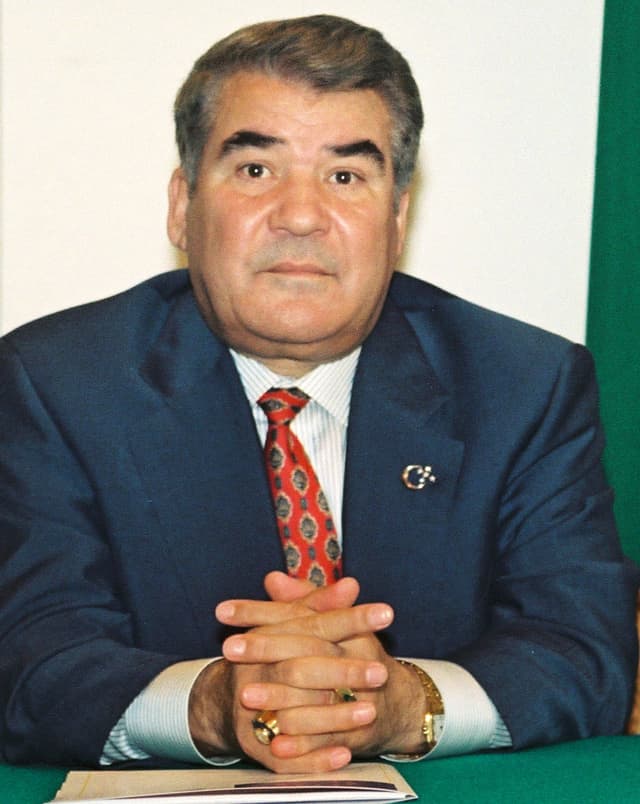
Saparmurat Niyazov
1940 to 2006, head of the Turkmen Communist Party from 1985, then president of independent Turkmenistan until his death in December 2006
65/100
ACE Score: 65/100
Medium on the scale. An index, not a percentage.
75High
How total and coercive the leader’s power was.
60Medium
How devoted to and dependent on the leader followers became.
60Medium
How hard it was to leave.
(rule-based):Pattern: a closed system with little institutional restraint, where harm was aimed mainly at its own people. A label for these scores, not a forecast. The summary and caveats describe what actually happened.
Scores are an interpretation of published sources using the ACE scoring guide, not findings of fact. Inclusion does not classify anyone as a cult. Disclaimer
Niyazov was the Soviet-era party boss who became president of independent Turkmenistan and was named president for life in 1999. He called himself Turkmenbashi, 'Head of the Turkmens', and filled the country with his portraits and statues, including a golden statue in Ashgabat that turned to face the sun. His book, the Ruhnama, became compulsory reading in schools, universities and workplaces. The regime controlled all media, jailed critics and cut public services on his personal orders. His rule was strange and repressive but produced far fewer killings than most cases in this batch.
In academic terms, niyazov shows near-total epistemic closure produced through a sacralised text and cult rather than mass terror; closure was high, violence moderate, and the system rested almost entirely on one man, which made his succession an unconstitutional palace manoeuvre.
Where scholars disagree
The case that the framework fits
The Ruhnama functioned like a scripture, and the renaming of months and days after Niyazov and his mother shows a deliberate attempt to sacralise the leader, close to the cultic end of the scale.
The case that it does not fit, or overstates
Many scholars treat the cult as performance that officials and citizens went through without belief, closer to compliance than conversion, and stress that it rested on gas revenue and patronage rather than charisma.
The five walls
6.2 of 10
- 9
1.
Who decides what is real?
All newspapers, television and radio were state-run, and the Ruhnama was taught as a moral and spiritual guide in schools and required for exams. Internet access was tightly restricted and foreign media were largely unavailable.
- 5
2.
Are friends and family outside the group cut off?
After the alleged November 2002 assassination attempt, relatives of accused plotters were arrested, evicted or forcibly moved. Family life was not reorganised, but loyalty to Turkmenbashi was taught as a family duty through the Ruhnama.
- 7
3.
How hard is it to physically leave?
Citizens needed exit visas for most of his rule; the requirement was lifted, reimposed after the November 2002 assassination attempt and abolished again in January 2004, but informal travel blacklists continued. Border regions were restricted and foreigners faced strict controls.
- 4
4.
Is an apocalypse or a destined triumph always near?
The regime proclaimed a 'Golden Age' of the Turkmen nation, and the Ruhnama presented national history as a destiny fulfilled under Niyazov. This framed daily ritual but did not predict a catastrophe or end.
- 6
5.
Does the group decide who deserves to live?
Opponents were imprisoned after show-trial confessions, and torture in custody was widely reported. Journalist Ogulsapar Muradova died in custody in 2006, but there was no mass killing.
Debt, dependence and harm
6 of 10, medium
How much do followers feel they owe?
Knowledge of the Ruhnama was tested for jobs, university entry and reportedly driving licences, and officials swore loyalty oaths. Public sector workers were mobilised for mass parades and depended on the state for wages and housing.
8 of 10, high
How far does everything rest on one person?
Ministers were dismissed and jailed at will, and no office held authority apart from Niyazov. On his death the constitutional successor, the parliamentary speaker, was arrested and Gurbanguly Berdimuhamedov took power instead.
+1, little harm, or balanced
When the system turns violent, where does the harm go?
Lethal violence was limited. Under the regime rule, harassment and deaths in custody of journalists and dissidents count as outward, while the jailing of former ministers and officials after the 2002 attempt counts as inward; the net leans slightly outward. Turkmenistan declared permanent neutrality and fought no wars.
Methods of control
Specific techniques from the historical record that kept followers loyal and the bubble sealed.
- 01Compulsory study of the Ruhnama in schools, universities and workplaces
- 02State monopoly of all media and restricted internet
- 03Exit visas and travel blacklists
- 04Show trials with televised confessions after the 2002 attempt
- 05Arbitrary dismissal and jailing of officials
- 06Renaming months, cities and institutions after the leader and his family
Against the reference cases
State power, violence aimed outward
Compared with Hitler
Like Hitler, Niyazov tied national identity to his person, but he led no mass movement and launched no war or genocide.
A sealed group, violence aimed inward
Compared with Jones
Like Jones, he made his own text and moods law for a closed population, but Turkmen citizens lived ordinary family lives and were not pushed toward collective death.
Through the theorists
Niyazov's authority was not genuine charisma but a staged imitation of it, layered on top of a Soviet patrimonial apparatus.
Chehabi and Linz
Turkmenistan fits their model of a sultanistic regime: rule by personal whim, weak institutions, a family-centred cult and fusion of state and ruler.
Exit was blocked by visas and blacklists and voice by prison, leaving only performed loyalty.
Key sources
Moderate evidence base
- Peyrouse, Sébastien (2012). Turkmenistan: Strategies of Power, Dilemmas of Development.
- Clement, Victoria (2018). Learning to Become Turkmen: Literacy, Language, and Power, 1914–2014.
Caveats
Turkmenistan was one of the most closed states in the world, so much evidence comes from exiles, human rights groups and foreign journalists, and some widely repeated anecdotes are hard to verify. The exit-visa regime formally ended in 2004, so spatial closure was lower in his final years. Some observers call the regime totalitarian, but it is classed here as an authoritarian ruler because control rested on personal rule and patronage rather than a mass party or mass terror. The vector of +1 reflects few killings: dissidents and journalists on the outward side, purged officials on the inward side.
Cite this profile
Koziol, T. (2026). Saparmurat Niyazov. In ACE: Authority, Cult & Exit (Version 1.1, pilot database). Ceraluna Labs. https://cultornot.com/leader/saparmurat-niyazov