From the ACE database. Researched and checked against published sources.
Silvio Berlusconi
1936 to 2023, media owner who became prime minister in 1994, 2001 to 2006 and 2008 to 2011
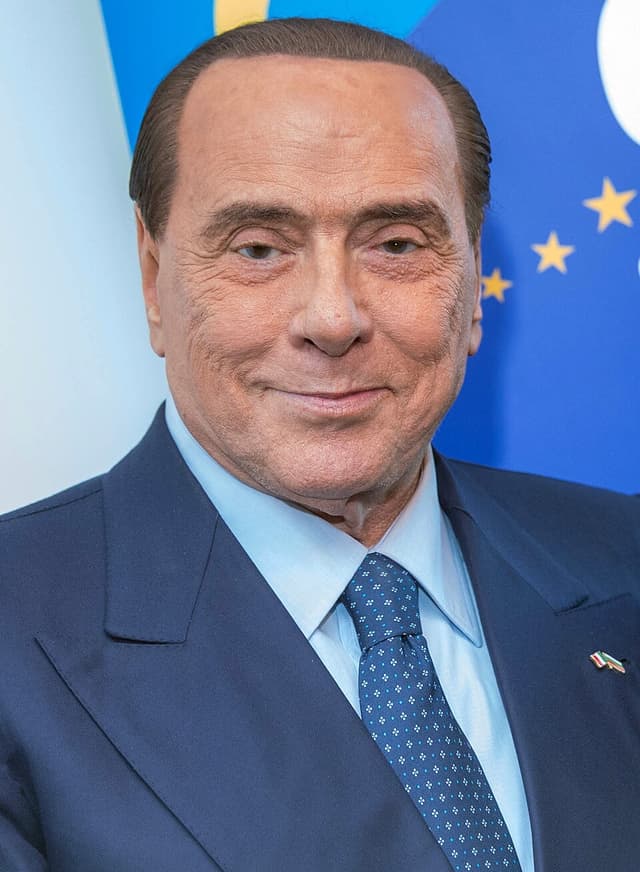
European People’s Party, CC BY 2.0, via Wikimedia Commons
14/100
ACE Score: 14/100
Low on the scale. An index, not a percentage.
20Low
How total and coercive the leader’s power was.
23Low
How devoted to and dependent on the leader followers became.
0Low
How hard it was to leave.
(rule-based):Pattern: walls low enough (Bubble Score under 5) for followers to leave fairly easily. A label for these scores, not a forecast. The summary and caveats describe what actually happened.
Scores are an interpretation of published sources using the ACE scoring guide, not findings of fact. Inclusion does not classify anyone as a cult. Disclaimer
Silvio Berlusconi was an Italian businessman who owned the country's largest private television group, Mediaset. He founded the party Forza Italia in 1994 and won that year's election, then served as prime minister three times. His governments passed laws that helped him in his own court cases, and critics said he controlled most national television. His coalition lost the 1996 and 2006 elections, and after briefly disputing the narrow 2006 result he left office, and in 2013 he was convicted of tax fraud and expelled from the Senate.
In academic terms, berlusconi shows media-driven personal politics within a working democracy; epistemic closure was modest and every other closure low, because courts, elections and a free press constrained him.
Where scholars disagree
The case that the framework fits
Ginsborg and Stille describe a leader who merged media ownership with state power, passed laws to protect himself from prosecution and turned a party into a personal vehicle.
The case that it does not fit, or overstates
Others note that he won and lost free elections, left office when defeated, faced courts that struck down his immunity laws, and governed amid a lively opposition press.
The five walls
1 of 10
- 3
1.
Who decides what is real?
As prime minister he owned Mediaset and influenced the state broadcaster RAI, and in 2002 journalists Enzo Biagi and Michele Santoro were removed after he criticised them. Freedom House rated Italy's press 'partly free' in 2004, but critical newspapers stayed open.
- 0
2.
Are friends and family outside the group cut off?
No interference with family life.
- 0
3.
How hard is it to physically leave?
Italians moved freely.
- 1
4.
Is an apocalypse or a destined triumph always near?
He warned of a communist threat to freedom. This was campaign rhetoric, not a destiny ideology.
- 1
5.
Does the group decide who deserves to live?
He attacked judges as politically motivated and 'mentally disturbed'. There was no dehumanisation or targeting of critics with harm.
Debt, dependence and harm
2 of 10, low
How much do followers feel they owe?
Forza Italia relied on loyalty to him and drew many candidates from his own companies, but citizens owed him nothing.
4 of 10, medium
How far does everything rest on one person?
The Italian state remained institutionalised and replaced him by procedure several times. His party was personal and had no clear succession.
0, little harm, or balanced
When the system turns violent, where does the harm go?
No political violence directed by him. Police violence at the 2001 Genoa G8 occurred under his government but was not ordered by him.
Methods of control
Specific techniques from the historical record that kept followers loyal and the bubble sealed.
- 01Ownership of major TV channels
- 02Influence over state broadcaster appointments
- 03Personal party built around his image
- 04Laws aiding his own legal cases
- 05Campaigns framing opponents as communists
- 06Attacks on judges' legitimacy
Against the reference cases
Through the theorists
Personal charisma used inside a legal-rational state that limited and finally removed him.
Ginsborg
Argued that his fusion of television ownership, political office and private wealth created a new kind of media-based power.
Mudde
A case of populist style in a democracy, often seen as a forerunner of later European populism.
Key sources
Strong evidence base
- Ginsborg, Paul (2004). Silvio Berlusconi: Television, Power and Patrimony.
- Stille, Alexander (2006). The Sack of Rome: How a Beautiful European Country with a Fabled History and a Storied Culture Was Taken Over by a Man Named Silvio Berlusconi.
Caveats
Some critics see real democratic erosion in his media power and immunity laws. His control was strongest from 2001 to 2006 and 2008 to 2011.
Cite this profile
Koziol, T. (2026). Silvio Berlusconi. In ACE: Authority, Cult & Exit (Version 1.1, pilot database). Ceraluna Labs. https://cultornot.com/leader/silvio-berlusconi