From the ACE database. Researched and checked against published sources.
Abu Bakr al-Baghdadi
1971 to 2019, leader of the Islamic State of Iraq from 2010 and self-declared caliph from 2014
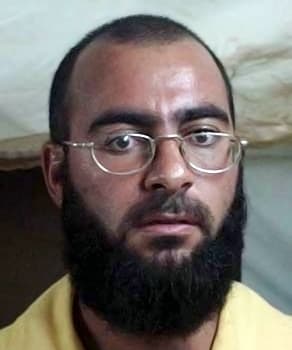
U.S Army, Public domain, via Wikimedia Commons
77/100
ACE Score: 77/100
High on the scale. An index, not a percentage.
95High
How total and coercive the leader’s power was.
67Medium
How devoted to and dependent on the leader followers became.
70High
How hard it was to leave.
(rule-based):Pattern: a closed system with strong offices, rules and succession. A label for these scores, not a forecast. The summary and caveats describe what actually happened.
Scores are an interpretation of published sources using the ACE scoring guide, not findings of fact. Inclusion does not classify anyone as a cult. Disclaimer
Baghdadi took over the Islamic State of Iraq in 2010 and expanded it into Syria. In June 2014 the group declared a caliphate and he appeared in Mosul as caliph, demanding the loyalty of all Muslims. At its height the group held territory with millions of people and ran courts, taxes and religious police. It committed genocide against the Yazidis and carried out or inspired attacks abroad. He died in a US raid in Syria in 2019.
In academic terms, baghdadi's Islamic State combined near-total epistemic and spatial closure with an explicit end-times narrative, while a bureaucratic state apparatus gave it more routinization than most militant movements. Its vector was overwhelmingly outward, reaching genocide.
Where scholars disagree
The case that the framework fits
McCants and Wood argue that apocalyptic belief and literal readings of scripture were central to the group's appeal and conduct, which fits the millenarian and high-closure profile.
The case that it does not fit, or overstates
Other researchers, including Weiss and Hassan, stress former Baathist officers, tribal politics and state collapse, seeing the group as a pragmatic insurgent state using religious language. Many scholars of Islam reject its theological claims entirely.
The five walls
8.2 of 10
- 9
1.
Who decides what is real?
The group banned satellite dishes and restricted internet access, ran its own media, and punished dissent or apostasy with public execution.
- 6
2.
Are friends and family outside the group cut off?
Foreign recruits were urged to emigrate and cut ties with 'apostate' relatives; the group arranged marriages and indoctrinated children in its schools and camps.
- 8
3.
How hard is it to physically leave?
Residents needed permission to leave caliphate territory, smugglers who helped people flee were punished, and deserters were executed.
- 8
4.
Is an apocalypse or a destined triumph always near?
Its propaganda framed the war as the prelude to a final battle at Dabiq in Syria, drawing on prophecies about the end of days, as McCants documents.
- 10
5.
Does the group decide who deserves to live?
A UN commission found in 2016 that the group committed genocide against the Yazidis, killing men and enslaving women and girls; mass executions of prisoners and minorities were filmed.
Debt, dependence and harm
8 of 10, high
How much do followers feel they owe?
Members swore an oath of allegiance to the caliph; foreign fighters gave up passports, homes and families, and local residents depended on the group for food, salaries and safety.
4 of 10, medium
How far does everything rest on one person?
The group ran ministries (diwans), provinces and governors, and after Baghdadi's death it named a successor within days and continued to operate.
+10, mostly outsiders
When the system turns violent, where does the harm go?
Violence targeted Yazidis, Shia, Christians, Kurds and Sunni opponents, along with terror attacks abroad; the Yazidi genocide anchors the top score.
Methods of control
Specific techniques from the historical record that kept followers loyal and the bubble sealed.
- 01Oath of allegiance to the caliph
- 02Religious police (hisba) and public punishment
- 03Control of information and media
- 04Exit restrictions and execution of deserters
- 05Arranged marriages and child indoctrination
- 06End-times narrative of a final battle
Against the reference cases
State power, violence aimed outward
Compared with Hitler
Like Hitler's state, the caliphate combined total ideological claims, territorial control and genocide, though on a far smaller scale and for a few years.
A sealed group, violence aimed inward
Compared with Jones
Like Jones, Baghdadi asked followers to cut all prior ties and migrate to a sealed community, but the violence was aimed outward.
Through the theorists
Baghdadi's claim rested on a religious office (caliph) more than personal magnetism; he appeared publicly very rarely, and the bureaucracy carried much of the authority.
Mark Juergensmeyer
The war was framed as a cosmic struggle between good and evil, which justified extreme violence and ruled out compromise.
Hannah Arendt
Terror, an all-explaining ideology and the destruction of private life give the caliphate a strong family resemblance to totalitarian rule.
Key sources
Strong evidence base
- McCants, William (2015). The ISIS Apocalypse: The History, Strategy, and Doomsday Vision of the Islamic State.
- Weiss, Michael, and Hassan Hassan (2015). ISIS: Inside the Army of Terror.
Caveats
Baghdadi himself was little seen, so much of the profile describes the organisation. Territorial control peaked in 2014 to 2016 and collapsed by 2019. Some accounts come from defectors and intelligence services with their own agendas.
Cite this profile
Koziol, T. (2026). Abu Bakr al-Baghdadi. In ACE: Authority, Cult & Exit (Version 1.1, pilot database). Ceraluna Labs. https://cultornot.com/leader/abu-bakr-al-baghdadi