From the ACE database. Researched and checked against published sources.
Enver Hoxha
1908 to 1985, leader of the Albanian Communists from wartime and ruler of Albania from 1944 until his death in April 1985
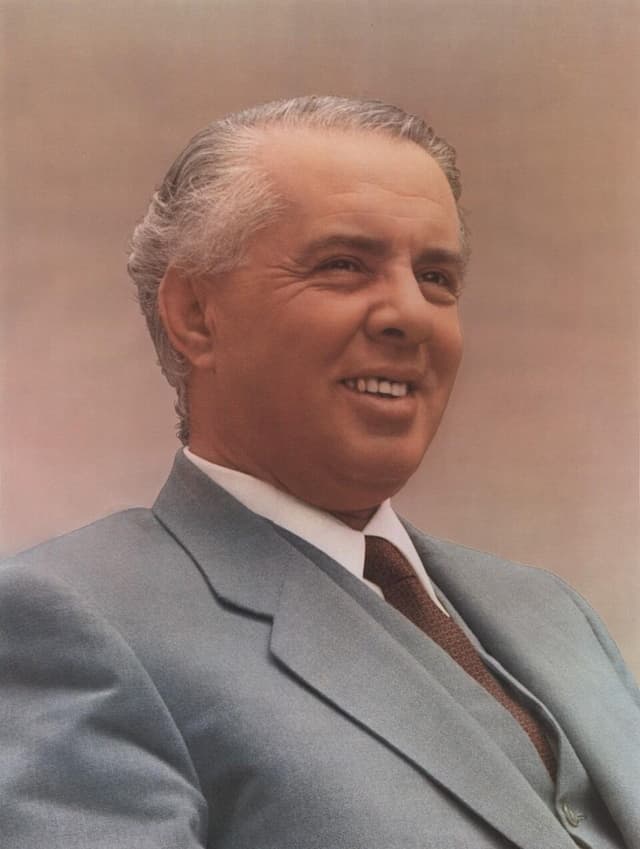
Petrit Kumi, Public domain, via Wikimedia Commons
77/100
ACE Score: 77/100
High on the scale. An index, not a percentage.
85High
How total and coercive the leader’s power was.
57Medium
How devoted to and dependent on the leader followers became.
90High
How hard it was to leave.
(rule-based):Pattern: a closed system with strong offices, rules and succession. A label for these scores, not a forecast. The summary and caveats describe what actually happened.
Scores are an interpretation of published sources using the ACE scoring guide, not findings of fact. Inclusion does not classify anyone as a cult. Disclaimer
Hoxha ruled Albania for four decades and cut ties in turn with Yugoslavia in 1948, the Soviet Union in 1961 and China in 1978. Albania became one of the most isolated countries in the world. In 1967 he declared it the world's first atheist state and closed all churches and mosques. Well over 100,000 concrete bunkers were built for an invasion that never came, and families of anyone who fled or dissented were sent to internment camps.
In academic terms, hoxha's Albania reached near-total spatial and epistemic closure, with lethal violence aimed mainly at citizens branded class and political enemies and secondarily at purged party comrades, under a siege ideology that kept the country braced for attack.
Where scholars disagree
The case that the framework fits
Fevziu shows Hoxha's personal control over purges and the cult around him. The siege ideology, family punishment and sealed borders match the closures of a high-control group.
The case that it does not fit, or overstates
Some scholars see Albania mainly as a poor, small state using isolation for survival against larger neighbours, with nationalism doing much of the binding work. Devotion to Hoxha personally was weaker than to party and nation.
The five walls
8.2 of 10
- 9
1.
Who decides what is real?
All media, schooling and culture followed the party line, and religion was banned outright in 1967. Some Albanians secretly watched Italian or Yugoslav television, which shows control was not perfect.
- 8
2.
Are friends and family outside the group cut off?
Relatives of defectors and political prisoners were sent to internment villages, sometimes for decades. Neighbours and family members were pressed to inform, and a 'bad biography' passed from parents to children.
- 10
3.
How hard is it to physically leave?
The borders were fenced and guarded, and people caught trying to escape were often shot. Private cars were banned for ordinary citizens and travel abroad was almost impossible.
- 6
4.
Is an apocalypse or a destined triumph always near?
Propaganda told Albanians they were encircled by imperialist and revisionist enemies who could invade at any moment. The bunker programme and military drills turned this into daily preparation.
- 8
5.
Does the group decide who deserves to live?
Post-communist research counts about 5,500 death sentences, and tens of thousands passed through prisons and labour camps such as Spaç and Burrel, with tens of thousands more interned. Clergy, pre-war elites and purged party leaders were labelled enemies of the people.
Debt, dependence and harm
7 of 10, high
How much do followers feel they owe?
The state owned all land and property after collectivisation and controlled every job and ration. Citizens joined compulsory 'voluntary' labour campaigns and were expected to denounce enemies.
4 of 10, medium
How far does everything rest on one person?
The party apparatus was disciplined and Hoxha prepared Ramiz Alia as his successor, who took over smoothly in 1985. But Hoxha purged even his closest comrades, such as Prime Minister Mehmet Shehu, who died in 1981 and was then denounced as a foreign spy.
+3, mostly outsiders
When the system turns violent, where does the harm go?
Outward: most victims were people the regime branded enemies, including pre-war elites, clergy, political opponents and people shot trying to cross the border. Inward: repeated purges of party and army leaders, from Koçi Xoxe in 1949 to Mehmet Shehu's circle in 1981; with no wars and no famine, the net is moderately outward.
Methods of control
Specific techniques from the historical record that kept followers loyal and the bubble sealed.
- 01Total isolation from foreign states
- 02Ban on all religion
- 03Internment of families of defectors
- 04Guarded and fenced borders
- 05Bunkers and constant invasion drills
- 06Purges of party leaders
- 07State ownership of all property
Against the reference cases
State power, violence aimed outward
Compared with Hitler
Hoxha matched Hitler in sealing his country, but fought no wars and aimed his violence at Albanians branded enemies and at his own party.
A sealed group, violence aimed inward
Compared with Jones
Hoxha's Albania, like Jonestown, was a closed world convinced that hostile outsiders were about to attack, though it did not end in collective death.
Through the theorists
Hoxha combined personal charisma as the wartime liberator with a disciplined bureaucracy that outlived him.
Continuous purges and the search for hidden enemies fit Arendt's model of totalitarian terror.
Coser
Lewis Coser's 'greedy institutions' describes a state that claimed citizens' whole loyalty and left no room for religion or private ties.
Key sources
Moderate evidence base
- Fevziu, Blendi (2016). Enver Hoxha: The Iron Fist of Albania.
- O'Donnell, James S. (1999). A Coming of Age: Albania under Enver Hoxha.
- Vickers, Miranda (1995). The Albanians: A Modern History.
Caveats
Figures for executions, prisoners and border deaths vary between sources, and many records are still being studied; estimates of political prisoners range from about 14,500 to 34,000 and of internees from about 21,000 to 60,000. Control tightened after 1967 and again after the break with China in 1978. On the vector, killings and imprisonment of class enemies, clergy, opponents and escapees count as outward; the purges of party and army leaders count as inward. Bunker counts range from about 170,000 to several hundred thousand.
Cite this profile
Koziol, T. (2026). Enver Hoxha. In ACE: Authority, Cult & Exit (Version 1.1, pilot database). Ceraluna Labs. https://cultornot.com/leader/enver-hoxha