From the ACE database. Researched and checked against published sources.
Augusto Pinochet
1915 to 2006, army commander who led the 1973 coup and ruled Chile until 1990
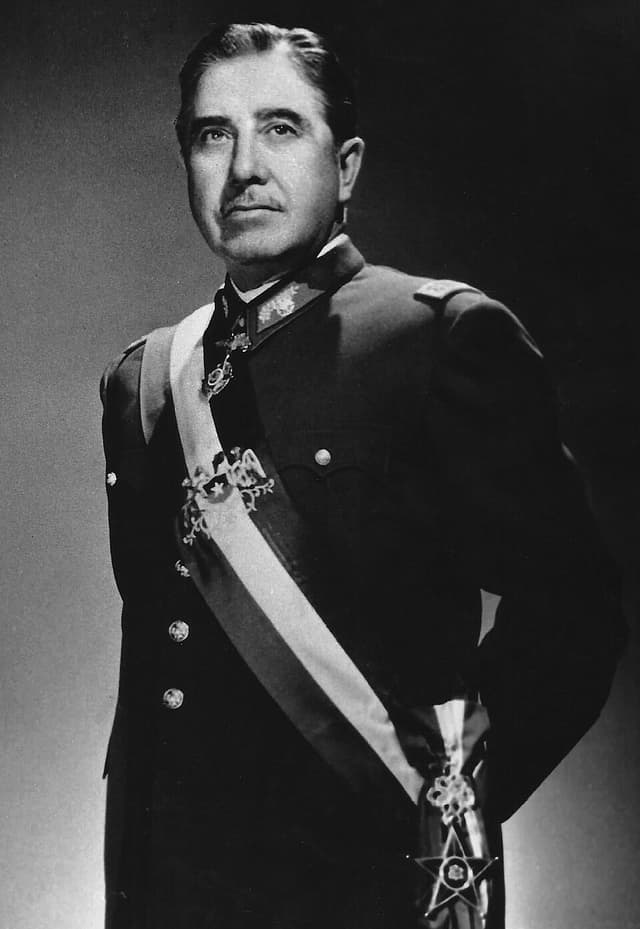
Ministerio de Relaciones Exteriores de Chile, CC BY 2.0 cl, via Wikimedia Commons
42/100
ACE Score: 42/100
Medium on the scale. An index, not a percentage.
65Medium
How total and coercive the leader’s power was.
30Low
How devoted to and dependent on the leader followers became.
30Low
How hard it was to leave.
(rule-based):Pattern: walls low enough (Bubble Score under 5) for followers to leave fairly easily. A label for these scores, not a forecast. The summary and caveats describe what actually happened.
Scores are an interpretation of published sources using the ACE scoring guide, not findings of fact. Inclusion does not classify anyone as a cult. Disclaimer
Augusto Pinochet led the military coup that overthrew elected president Salvador Allende in September 1973. His regime banned parties, closed Congress and used the DINA secret police to kill, disappear and torture opponents. Chile's truth commissions later recognised about 3,200 people killed or disappeared and about 38,000 survivors of political imprisonment and torture. His government also carried out free-market reforms. He lost a 1988 plebiscite and handed power to an elected president in 1990.
In academic terms, pinochet shows high existential closure against opponents with low social and temporal closure: the regime demanded obedience, not devotion, and it ended through a procedure written into its own constitution.
Where scholars disagree
The case that the framework fits
Constable and Valenzuela show a regime that treated a large part of the nation as 'enemies', used torture and disappearance, and presented Pinochet as the man who saved Chile from Marxism.
The case that it does not fit, or overstates
Pinochet had little charismatic pull and no doctrine demanding personal devotion; his supporters credit him with preventing civil war and building a strong economy. Many scholars see him as a military dictator, not a cult leader, and a large share of Chileans voted for him to stay in the 1988 plebiscite.
The five walls
4.2 of 10
- 6
1.
Who decides what is real?
Left-wing newspapers were closed after the coup, the media were censored and universities were placed under military rectors. Some opposition magazines and Church publications operated with restrictions in the 1980s.
- 3
2.
Are friends and family outside the group cut off?
The regime did not try to reorganise family life, but families of the disappeared were left without answers and watched. Pinochet presented the regime as defending the traditional family.
- 3
3.
How hard is it to physically leave?
Hundreds of thousands of Chileans went into exile, and many were barred from returning, with letters marking passports. Leaving the country was usually possible.
- 2
4.
Is an apocalypse or a destined triumph always near?
The junta presented itself as saving Chile from Marxism and rebuilding the nation. It had no millennial vision beyond order and economic modernisation.
- 7
5.
Does the group decide who deserves to live?
The Rettig commission (1991) and its successors recognised about 3,200 people killed or disappeared, including victims of the 1973 'Caravan of Death'. Junta leaders described Marxism as a 'cancer' to be cut out.
Debt, dependence and harm
3 of 10, low
How much do followers feel they owe?
Ordinary citizens were not required to show active devotion, but informers were used and public employees were purged. Military officers were bound by loyalty and complicity in abuses.
4 of 10, medium
How far does everything rest on one person?
The 1980 constitution set a plebiscite for 1988, and when Pinochet lost it he stepped aside in 1990 while remaining army chief until 1998. Political scientists note he concentrated power over the junta more than in other South American military regimes.
+6, mostly outsiders
When the system turns violent, where does the harm go?
Outward: nearly all killings fell on people the regime defined as enemies, namely leftists, unionists and other opponents, and there were few purges of its own officers. Through Operation Condor the DINA killed opponents abroad, including Orlando Letelier, killed by a car bomb in Washington, D.C., in 1976.
Methods of control
Specific techniques from the historical record that kept followers loyal and the bubble sealed.
- 01Secret police (DINA, later CNI) with detention centres such as Villa Grimaldi
- 02Forced disappearance to spread fear and deny responsibility
- 03Censorship and closure of parties, unions and Congress
- 04Exile and bans on return
- 05Transnational assassinations through Operation Condor
- 06A constitution that locked in military influence after his rule
Against the reference cases
State power, violence aimed outward
Compared with Hitler
Pinochet shared Hitler's anti-Marxist crusade and political terror but had no racial ideology, no war of aggression and accepted defeat at the ballot box.
A sealed group, violence aimed inward
Compared with Jones
Pinochet asked for obedience, not belief; Chileans could leave, and there was no communal life or demand for self-sacrifice.
Through the theorists
Pinochet relied mostly on legal-rational and coercive authority drawn from the army hierarchy rather than personal charisma.
Guillermo O'Donnell
Chile fits O'Donnell's model of bureaucratic authoritarianism, where the military and technocrats exclude popular sectors to reorder the economy.
Steve Stern
Stern shows how Chileans formed competing 'memory boxes' of the regime, as salvation or as cruelty, which keeps the case contested.
Key sources
Strong evidence base
- Constable, Pamela, and Arturo Valenzuela (1991). A Nation of Enemies: Chile Under Pinochet.
- Stern, Steve J. (2004). Remembering Pinochet's Chile: On the Eve of London 1998.
Caveats
Classified as an authoritarian ruler because this was a military dictatorship centred on one commander. Violence peaked from 1973 to 1977 and fell later. Victim figures are official commission counts and are among the best documented in this batch.
Cite this profile
Koziol, T. (2026). Augusto Pinochet. In ACE: Authority, Cult & Exit (Version 1.1, pilot database). Ceraluna Labs. https://cultornot.com/leader/augusto-pinochet