From the ACE database. Researched and checked against published sources.
John Humphrey Noyes
1811 to 1886, Perfectionist movement and Oneida Community, active in Putney, Vermont, and Oneida, New York
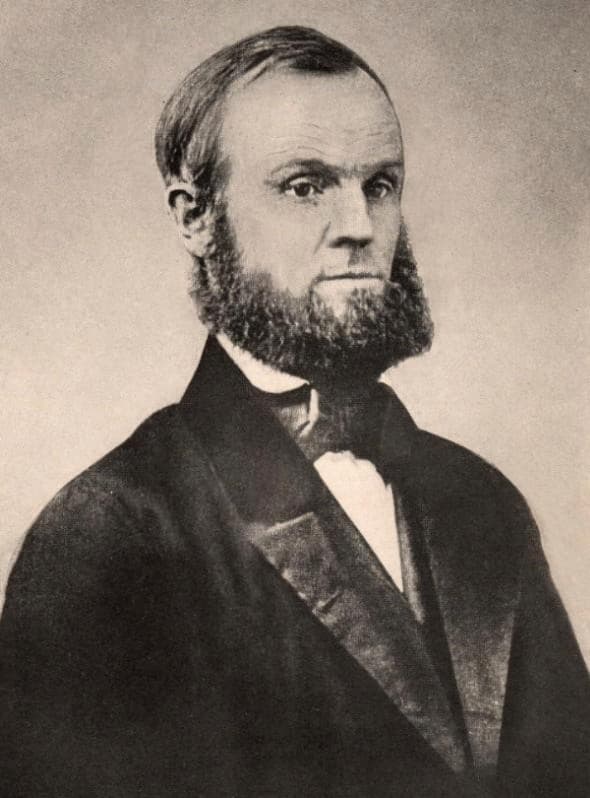
unknown Uploaded by User:Epousesquecido (also w:User:Epousesquecido), Public domain, via Wikimedia Commons
40/100
ACE Score: 40/100
Medium on the scale. An index, not a percentage.
25Low
How total and coercive the leader’s power was.
50Medium
How devoted to and dependent on the leader followers became.
45Medium
How hard it was to leave.
(rule-based):Pattern: walls low enough (Bubble Score under 5) for followers to leave fairly easily. A label for these scores, not a forecast. The summary and caveats describe what actually happened.
Scores are an interpretation of published sources using the ACE scoring guide, not findings of fact. Inclusion does not classify anyone as a cult. Disclaimer
John Humphrey Noyes taught that Christ had already returned and that believers could live free of sin. At Oneida, from 1848, about 300 members held all property in common and practised 'complex marriage', in which exclusive couples were forbidden and sexual partners were arranged through intermediaries. From 1869 Noyes ran a selective breeding programme called stirpiculture. Facing a threatened prosecution, he fled to Canada in 1879; the community ended complex marriage that year and became a joint-stock company in 1881.
In academic terms, oneida shows high social closure and devotion debt through regulated sexuality, mutual criticism and communal child-rearing, alongside low spatial and existential closure. Its collapse when Noyes left shows heavy leader dependence despite committee structures.
Where scholars disagree
The case that the framework fits
Control over sexuality, reproduction and child-rearing, plus regular public criticism, fit the definition of a high-control group, and Noyes's sexual access to young women was a central privilege of his position.
The case that it does not fit, or overstates
Foster and Klaw describe a prosperous, literate community that members entered and left freely, with relatively high status for women for its time. Many former members remembered Oneida fondly, and its business survived as a successful company.
The five walls
3.4 of 10
- 4
1.
Who decides what is real?
Noyes's theology was the community's guide and mutual criticism sessions corrected members whose thinking strayed. Members were well educated, read widely and published their own paper, the Circular.
- 6
2.
Are friends and family outside the group cut off?
Exclusive romantic attachment and close mother and child bonds were criticised as 'special love', and children were raised in a children's house. From 1869 a committee chose which couples could have children.
- 3
3.
How hard is it to physically leave?
Members lived together in the Mansion House but could leave, and some did. The community traded openly with outsiders through its businesses.
- 3
4.
Is an apocalypse or a destined triumph always near?
Noyes held that the Second Coming had occurred in AD 70 and that the kingdom of heaven could be built now. This was utopian rather than catastrophic.
- 1
5.
Does the group decide who deserves to live?
Outsiders were seen as living in sin but not as enemies. No harassment or violence against critics is recorded.
Debt, dependence and harm
6 of 10, medium
How much do followers feel they owe?
All property was held in common and sexual access was regulated by older members under the system of 'ascending fellowship'. Mutual criticism sessions required members to submit to public correction.
6 of 10, medium
How far does everything rest on one person?
Committees ran the community's industries, including traps and later silverware. Noyes's attempt to pass leadership to his son Theodore failed, and the system collapsed after he left.
-1, little harm, or balanced
When the system turns violent, where does the harm go?
Klaw documents that adolescent girls were introduced to sex by older men, often Noyes himself, which by modern standards was sexual abuse. There was no lethal violence.
Methods of control
Specific techniques from the historical record that kept followers loyal and the bubble sealed.
- 01Mutual criticism sessions
- 02Complex marriage and the ban on 'special love'
- 03Ascending fellowship placing young members under older ones
- 04Communal child-rearing in a children's house
- 05Stirpiculture committee controlling reproduction
- 06Common ownership of all property
Against the reference cases
State power, violence aimed outward
Compared with Hitler
Stirpiculture shares a eugenic logic with Nazi race policy, but it was voluntary, small and non-violent. Oneida had no enemies to destroy.
A sealed group, violence aimed inward
Compared with Jones
Both leaders used sexual access and public confession to bind members. Oneida stayed open and prosperous and ended by negotiation, not death.
Through the theorists
Noyes's theological charisma never transferred to an office, so the community could not survive his departure in its original form.
Kanter uses Oneida as a leading example of successful commitment mechanisms such as mutual criticism and the abolition of exclusive couples.
Foucault
Oneida's management of desire, reproduction and confession can be read as a small-scale experiment in disciplinary power over bodies.
Key sources
Strong evidence base
- Klaw, Spencer (1993). Without Sin: The Life and Death of the Oneida Community.
- Foster, Lawrence (1981). Religion and Sexuality: Three American Communal Experiments of the Nineteenth Century.
Caveats
Earlier histories, some written by descendants, were sympathetic; later work by Klaw and Wayland-Smith gives more weight to sexual exploitation. Control was highest from about 1869 to 1879.
Cite this profile
Koziol, T. (2026). John Humphrey Noyes. In ACE: Authority, Cult & Exit (Version 1.1, pilot database). Ceraluna Labs. https://cultornot.com/leader/john-humphrey-noyes