From the ACE database. Researched and checked against published sources.
Muhammad Ahmad
1844 to 1885, the Sudanese Mahdi, leader of the Mahdist revolt against Egyptian-Ottoman rule
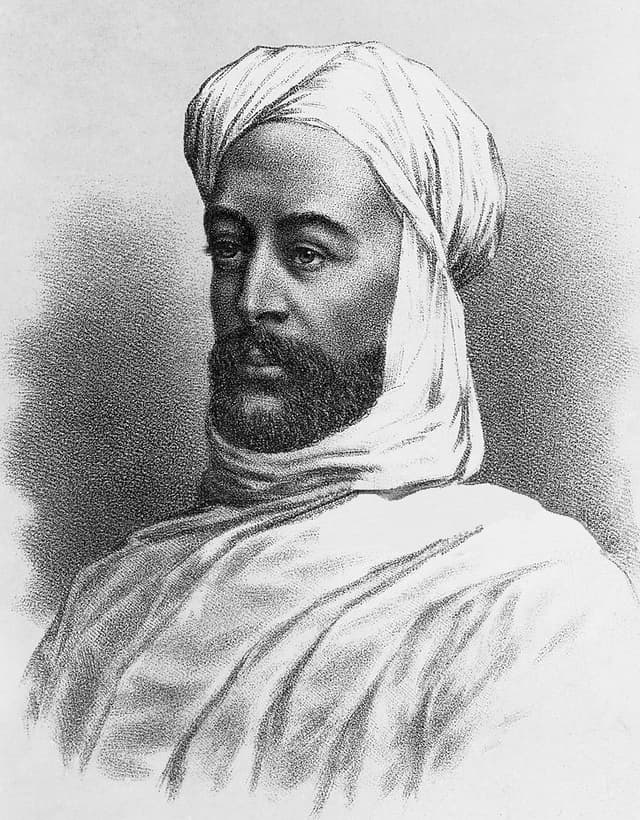
Unknown author, Public domain, via Wikimedia Commons
57/100
ACE Score: 57/100
Medium on the scale. An index, not a percentage.
70High
How total and coercive the leader’s power was.
57Medium
How devoted to and dependent on the leader followers became.
45Medium
How hard it was to leave.
(rule-based):Pattern: a closed system with strong offices, rules and succession. A label for these scores, not a forecast. The summary and caveats describe what actually happened.
Scores are an interpretation of published sources using the ACE scoring guide, not findings of fact. Inclusion does not classify anyone as a cult. Disclaimer
Muhammad Ahmad ibn Abdallah was a Sufi teacher who declared himself the Mahdi, the redeemer expected at the end of time, in 1881. He led a revolt against Egyptian-Ottoman rule in Sudan, destroyed an army under Hicks Pasha in 1883 and captured Khartoum in January 1885, where General Gordon was killed. He enforced a strict Islamic code and required followers to swear allegiance and join the jihad. He died in June 1885, and his successor, the Khalifa Abdallahi, ruled the Mahdist state until British-Egyptian forces defeated it in 1898.
In academic terms, the Mahdi achieved high epistemic and existential closure through messianic claims and jihad, and directed violence outward in a war against Egyptian rule. Unusually for millenarian movements, his authority was routinised into a state that outlived him.
Where scholars disagree
The case that the framework fits
A leader claimed messianic status, declared doubters infidels, demanded oaths and property and led followers into a war framed as the end-time struggle.
The case that it does not fit, or overstates
Holt and Searcy show the movement drew on real grievances against heavy taxation and foreign rule, and that it became a functioning state. Many Sudanese view the Mahdi as a national liberation hero, and British sources painted him as a fanatic to justify reconquest.
The five walls
6 of 10
- 7
1.
Who decides what is real?
He claimed to receive direction from the Prophet, abolished the four legal schools and Sufi orders and had law books burned. Rejecting his mission was treated as unbelief.
- 4
2.
Are friends and family outside the group cut off?
Followers were expected to make hijra to join him, and family ties came second to the jihad. Marriage rules were reformed, with dowries capped.
- 5
3.
How hard is it to physically leave?
Followers gathered in armed camps around the Mahdi, and abandoning his cause in wartime was treated as apostasy. Tighter controls on travel came mainly under the Khalifa after 1885.
- 7
4.
Is an apocalypse or a destined triumph always near?
He presented the revolt as the end-time struggle, promising victory over Egypt and the conquest of Mecca, Cairo and Istanbul.
- 7
5.
Does the group decide who deserves to live?
Those who rejected his mission were declared infidels against whom jihad was lawful; he wrote that whoever did not believe in him would be purified by the sword. When Khartoum fell in January 1885, much of the garrison and many male inhabitants were killed.
Debt, dependence and harm
6 of 10, medium
How much do followers feel they owe?
Followers swore an oath of allegiance, gave up wealth to a central treasury and wore the patched jibba. They were expected to fight and die in jihad.
4 of 10, medium
How far does everything rest on one person?
He appointed khalifas, set up a treasury and courts, and named Khalifa Abdallahi as successor. The state lasted 13 years after his death.
+7, mostly outsiders
When the system turns violent, where does the harm go?
The movement fought a war against Egyptian-Ottoman forces and killed many soldiers and civilians, including at Khartoum. Members also died in large numbers in battle.
Methods of control
Specific techniques from the historical record that kept followers loyal and the bubble sealed.
- 01Claim to be the Expected Mahdi
- 02Oath of allegiance (bay'a)
- 03Abolition of rival legal schools and Sufi orders
- 04Central treasury and surrender of wealth
- 05Declaring opponents infidels
- 06Mass mobilisation for jihad
Against the reference cases
State power, violence aimed outward
Compared with Hitler
Both led wars framed by destiny, but the Mahdi was fighting to end Egyptian-Ottoman rule, and his state was regional and short-lived.
A sealed group, violence aimed inward
Compared with Jones
Unlike Jones, the Mahdi built a state with offices that survived him.
Through the theorists
The Mahdiyya is a rare case where charismatic authority was routinised into a state with a designated successor.
Holt
Holt explains the revolt as a fusion of messianic belief, economic grievance and resentment of Egyptian rule.
Searcy
Searcy shows how ceremony and symbols, such as dress, titles and public rituals, built and transferred authority.
Key sources
Moderate evidence base
- Holt, P. M. (1958). The Mahdist State in the Sudan, 1881–1898: A Study of Its Origins, Development and Overthrow.
- Searcy, Kim (2011). The Formation of the Sudanese Mahdist State: Ceremony and Symbols of Authority: 1882–1898.
Caveats
Category is 'religious' although the Mahdi founded a state. Much English-language material comes from British officers and former captives such as Rudolf Slatin, who had political reasons to paint the state as fanatical. The vector score counts an anti-colonial war as violence against outsiders; many readers would weigh that differently from aggression. Scores reflect the Mahdi's lifetime, not the Khalifa's later rule.
Cite this profile
Koziol, T. (2026). Muhammad Ahmad. In ACE: Authority, Cult & Exit (Version 1.1, pilot database). Ceraluna Labs. https://cultornot.com/leader/muhammad-ahmad-mahdi