From the ACE database. Researched and checked against published sources.
François Duvalier
1907 to 1971, country doctor elected president of Haiti in 1957, president for life from 1964, succeeded by his son Jean-Claude on his death
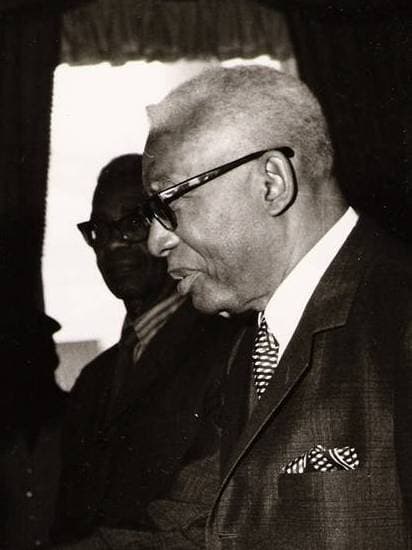
Unknown artist, Public domain, via Wikimedia Commons
57/100
ACE Score: 57/100
Medium on the scale. An index, not a percentage.
75High
How total and coercive the leader’s power was.
50Medium
How devoted to and dependent on the leader followers became.
45Medium
How hard it was to leave.
(rule-based):Pattern: a closed system with little institutional restraint, where harm was aimed mainly at outsiders. A label for these scores, not a forecast. The summary and caveats describe what actually happened.
Scores are an interpretation of published sources using the ACE scoring guide, not findings of fact. Inclusion does not classify anyone as a cult. Disclaimer
François 'Papa Doc' Duvalier was a doctor and black nationalist writer who won the army-supervised 1957 presidential election. He built a private militia, the Tonton Macoutes, that answered only to him and terrorised the population, and he neutralised the army. He cultivated an image linked to Vodou spirits and had a 'catechism' published that rewrote the Lord's Prayer around himself. He declared himself president for life in 1964 and arranged for his 19-year-old son to succeed him. Thousands were killed and many educated Haitians fled into exile.
In academic terms, duvalier fused terror with sacred symbolism, using a personal militia and religious imagery to make himself both feared and mystically untouchable; closure was high, and routinization took the form of dynastic succession rather than institutions.
Where scholars disagree
The case that the framework fits
The religious catechism, Vodou imagery and 'president for life' status show a deliberate sacralisation of the leader backed by terror.
The case that it does not fit, or overstates
Michel-Rolph Trouillot argues Duvalierism grew out of a long Haitian history of a predatory state against the nation, so it should not be read as one man's cult alone. Some scholars doubt that Duvalier's Vodou associations reflected real religious authority.
The five walls
5.4 of 10
- 7
1.
Who decides what is real?
Independent newspapers and radio were closed, and journalists were jailed or killed. The 1964 Catechism of the Revolution presented Duvalier in religious terms, including a version of the Lord's Prayer addressed to him.
- 5
2.
Are friends and family outside the group cut off?
Tonton Macoutes were present in every town and recruited informers among neighbours. In the 1964 Jérémie killings whole families of suspected opponents, including children, were murdered.
- 4
3.
How hard is it to physically leave?
Exile was the main escape, and a large share of Haiti's professionals left for the United States, Canada and Africa. The regime controlled travel documents and watched exiles.
- 3
4.
Is an apocalypse or a destined triumph always near?
Duvalier presented himself as the fulfilment of a black nationalist destiny for Haiti. There was no apocalyptic timetable.
- 8
5.
Does the group decide who deserves to live?
Opponents were tortured and killed at Fort Dimanche prison and by the Macoutes. Estimates of deaths under his rule are often given as about 30,000, though the figure is uncertain.
Debt, dependence and harm
5 of 10, medium
How much do followers feel they owe?
Macoutes and officials gained income and status through the regime, and citizens and businesses were forced to make 'voluntary' contributions. Survival in public life required visible loyalty.
7 of 10, high
How far does everything rest on one person?
Duvalier bypassed the army and civil service with his militia and kept all decisions personal. Succession was handled dynastically by naming his son, which kept the regime alive until 1986.
+6, mostly outsiders
When the system turns violent, where does the harm go?
Most violence counts as outward under the regime rule: opponents, rival elites, parts of the mulatto upper class, clergy and exile invaders, all defined as enemies. Purges of his own camp count as inward, including the 1967 execution of 19 officers of his presidential guard and the killing of his former Macoute chief Clément Barbot in 1963.
Methods of control
Specific techniques from the historical record that kept followers loyal and the bubble sealed.
- 01Personal militia (Tonton Macoutes) outside the army
- 02Terror and killings of opponents and their families
- 03Religious and Vodou symbolism around the leader
- 04Censorship and closure of independent media
- 05Forced financial contributions
- 06Dynastic succession to his son
Against the reference cases
State power, violence aimed outward
Compared with Hitler
Like Hitler, Duvalier built a party militia parallel to the army and used terror, but he led no expansionist war and no genocide.
A sealed group, violence aimed inward
Compared with Jones
Like Jones, Duvalier claimed quasi-religious powers, but his followers were rewarded with power over others rather than asked to give up their lives.
Through the theorists
Duvalier mixed manufactured charisma with patrimonial control, then tried to make it hereditary.
Trouillot
Trouillot reads Duvalierism as the culmination of a Haitian state structurally opposed to its own peasant majority.
Chehabi and Linz
Haiti under the Duvaliers is one of their classic sultanistic cases.
Key sources
Moderate evidence base
- Abbott, Elizabeth (1988). Haiti: The Duvaliers and Their Legacy.
- Trouillot, Michel-Rolph (1990). Haiti, State Against Nation: The Origins and Legacy of Duvalierism.
Caveats
Death tolls are uncertain and based on exile and human rights reports; the common figure of about 30,000 deaths is an estimate, not a count. Most of these deaths fall on the outward side of the vector, with purges of officers and Macoutes on the inward side. He is classed as an authoritarian ruler because his regime was sultanistic rather than a mass-party totalitarian state. His early years (1957 to 1964) saw rising rather than peak control.
Cite this profile
Koziol, T. (2026). François Duvalier. In ACE: Authority, Cult & Exit (Version 1.1, pilot database). Ceraluna Labs. https://cultornot.com/leader/francois-duvalier