From the ACE database. Researched and checked against published sources.
Ruhollah Khomeini
1902 to 1989, leader of the 1979 Iranian Revolution and first Supreme Leader of the Islamic Republic
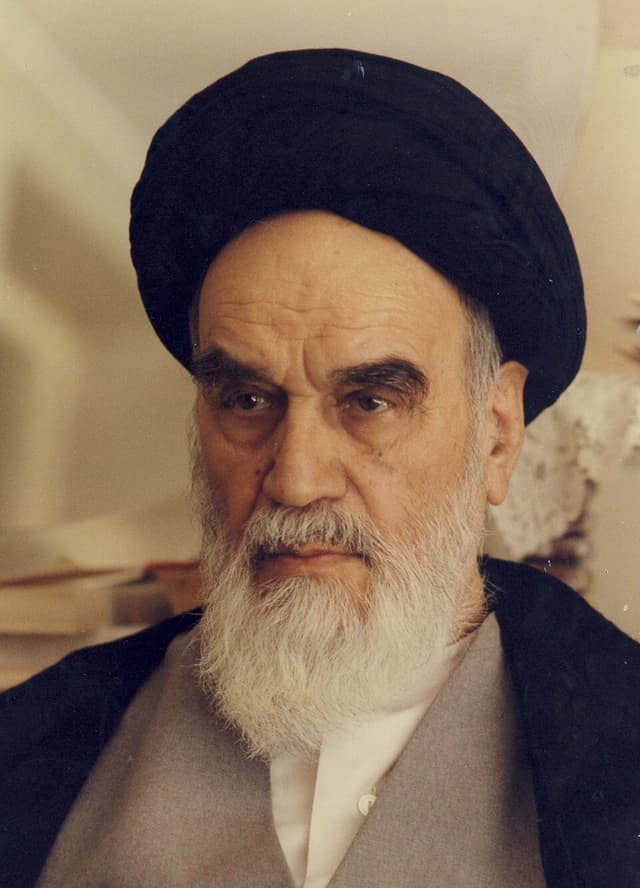
Unknown author, Public domain, via Wikimedia Commons
57/100
ACE Score: 57/100
Medium on the scale. An index, not a percentage.
75High
How total and coercive the leader’s power was.
50Medium
How devoted to and dependent on the leader followers became.
45Medium
How hard it was to leave.
(rule-based):Pattern: a closed system with strong offices, rules and succession. A label for these scores, not a forecast. The summary and caveats describe what actually happened.
Scores are an interpretation of published sources using the ACE scoring guide, not findings of fact. Inclusion does not classify anyone as a cult. Disclaimer
Ruhollah Khomeini was a Shi'a cleric who opposed the Shah from exile and returned in 1979 to lead the revolution that overthrew him. He built a new constitution around his doctrine that a senior jurist should guide the state. Under his rule the new regime suppressed rival revolutionary groups, imposed religious law on daily life and fought a long war with Iraq. In 1988 thousands of political prisoners were executed. After his death the Assembly of Experts chose a successor, and the system he built continued.
In academic terms, khomeini fused religious charisma with a written constitution, producing high epistemic and existential closure and a strong demand for sacrifice, yet comparatively high routinization because clerical institutions outlived him.
Where scholars disagree
The case that the framework fits
Abrahamian and others show forced confessions, mass executions and a leader whose word was treated as religious obligation, with followers urged to die for him in war.
The case that it does not fit, or overstates
Many historians stress that Khomeini led a genuine mass revolution with wide popular support, that Iran kept elections and factional debate, and that the war began with Iraq's invasion. Some scholars, including Abrahamian, describe his movement as a form of Third World populism rather than a cult.
The five walls
5.8 of 10
- 7
1.
Who decides what is real?
Opposition newspapers were closed from 1979 onward and universities were shut from 1980 to 1983 in a 'Cultural Revolution' to purge non-Islamic influences. Ervand Abrahamian documents televised forced recantations used to discredit dissenters.
- 5
2.
Are friends and family outside the group cut off?
Religious law reshaped family life, including compulsory hijab, lowered marriage age and gender segregation. Families divided over the opposition, and relatives of prisoners faced pressure to denounce them.
- 4
3.
How hard is it to physically leave?
Hundreds of thousands of Iranians emigrated after 1979, so exit was possible for many. Known opponents faced passport bans and arrest at the border, and opponents abroad were assassinated from 1979 onward, a campaign that continued after his death.
- 5
4.
Is an apocalypse or a destined triumph always near?
The revolution was framed as a struggle of the oppressed against arrogance, drawing on the Shi'a story of Karbala and martyrdom. Khomeini refused peace with Iraq for years, describing the war as a sacred defence.
- 8
5.
Does the group decide who deserves to live?
Thousands of members of the Mojahedin-e Khalq and leftist groups were executed in 1981 and 1982. In 1988, after a secret order from Khomeini, special commissions sent several thousand prisoners to execution, with estimates ranging from about 2,800 to over 5,000.
Debt, dependence and harm
6 of 10, medium
How much do followers feel they owe?
Volunteers in the Basij militia and Revolutionary Guards were urged toward martyrdom in the Iran-Iraq war, and the state rewarded martyrs' families. Jobs and university places came to depend on ideological screening.
4 of 10, medium
How far does everything rest on one person?
The 1979 constitution created the Supreme Leader, Guardian Council and Assembly of Experts. When Khomeini died in 1989 the Assembly chose Ali Khamenei and the system continued, although Khomeini had first dismissed his designated heir, Hossein-Ali Montazeri, in 1989.
+5, mostly outsiders
When the system turns violent, where does the harm go?
Outward: most killings by the state fell on opponents labelled 'hypocrites' or 'enemies of God', on Kurdish rebels in 1979 to 1980, on Baha'is and on exiles abroad, and the 1989 fatwa calling for Salman Rushdie's death extended the threat beyond Iran. Inward: former insiders such as ex-foreign minister Sadegh Ghotbzadeh were executed, and hundreds of thousands of Iranians, many of them Basij volunteers from the regime's loyal base, died in the war with Iraq, which Khomeini prolonged after 1982.
Methods of control
Specific techniques from the historical record that kept followers loyal and the bubble sealed.
- 01Doctrine of guardianship of the jurist placing a cleric above elected bodies
- 02Revolutionary courts and Revolutionary Guards outside ordinary law
- 03Televised forced confessions and recantations
- 04Purges of universities, the army and the civil service
- 05Martyrdom culture and rewards for families of the war dead
- 06Mass executions of political prisoners, above all in 1981 to 1982 and 1988
Against the reference cases
State power, violence aimed outward
Compared with Hitler
Both led mass movements that killed political enemies in large numbers, but Khomeini did not pursue racial genocide and fought a war Iraq had started.
A sealed group, violence aimed inward
Compared with Jones
Like Jones, Khomeini drew on religious authority and martyrdom, but he governed a large state with lasting institutions rather than a sealed commune.
Through the theorists
Khomeini is a strong case of charisma being routinised: his personal religious authority was written into offices that continued after his death.
Ervand Abrahamian
Khomeinism resembles populist movements elsewhere, mobilising the urban poor against foreign power and elites while using religious language.
Theda Skocpol
Skocpol argued that Shi'a networks and symbols allowed a revolution to be 'made' through mobilisation, which helps explain the depth of commitment Khomeini could call on.
Key sources
Strong evidence base
- Moin, Baqer (1999). Khomeini: Life of the Ayatollah.
- Abrahamian, Ervand (1993). Khomeinism: Essays on the Islamic Republic.
- Abrahamian, Ervand (1999). Tortured Confessions: Prisons and Public Recantations in Modern Iran.
Caveats
Death tolls for 1981 to 1988 come largely from opposition groups and human rights organisations, and official records remain closed. Moin's biography is relatively balanced but relies heavily on clerical sources. Scores reflect the peak of repression in the 1980s. Vector counts political and religious opponents as outward; purges of former revolutionaries and the mass death of the regime's own volunteers in the war count as inward, which pulls the net score down. Iran's offensives into Iraq after 1982 add some outward weight.
Cite this profile
Koziol, T. (2026). Ruhollah Khomeini. In ACE: Authority, Cult & Exit (Version 1.1, pilot database). Ceraluna Labs. https://cultornot.com/leader/ruhollah-khomeini